 Marcus FeldEditor-in-Chief
Nike QC Tracking: Spreadsheet vs Google Sheets
## The Size and QC Tasks This Nike Shoe Review Needs to Solve When you're browsing [Nike shoes](https://fashion-reps.net/shoes/nike) on fashion-reps.net, the real task isn't simply copying product links into a spreadsheet—it's building a set of evidence records you can revisit: which style each pair corresponds to, what size and color info is listed, whether the images support an initial review, whether the QC page is still accessible, and whether it's worth forwarding to a shopping agent for fu
Editor score 4.2 / 5
The Size and QC Tasks This Nike Shoe Review Needs to Solve
When you're browsing Nike shoes on fashion-reps.net, the real task isn't simply copying product links into a spreadsheet—it's building a set of evidence records you can revisit: which style each pair corresponds to, what size and color info is listed, whether the images support an initial review, whether the QC page is still accessible, and whether it's worth forwarding to a shopping agent for further confirmation. 👟
This guide is for anyone comparing Nike shoes, needing to organize candidate items, or wanting to create a shared review list with others. After reading, you should be able to do three things: locate products from the site catalog, build a structured record in Google Sheets, and check that size and QC evidence is complete before submitting candidates.
This guide is not a substitute for physical inspection, authenticating material, or promising any size will fit. The images and visible fields on the page support only initial screening; final sizing decisions still depend on the product page, seller info, measurement data, and the ordering process of your agent platform. The page review date for this article is October 13, 2026. Prices, stock, shipping, returns, and agent policies must be re-confirmed before placing any actual order.

First Verify the Visible Product Fields in the fashionreps Spreadsheet
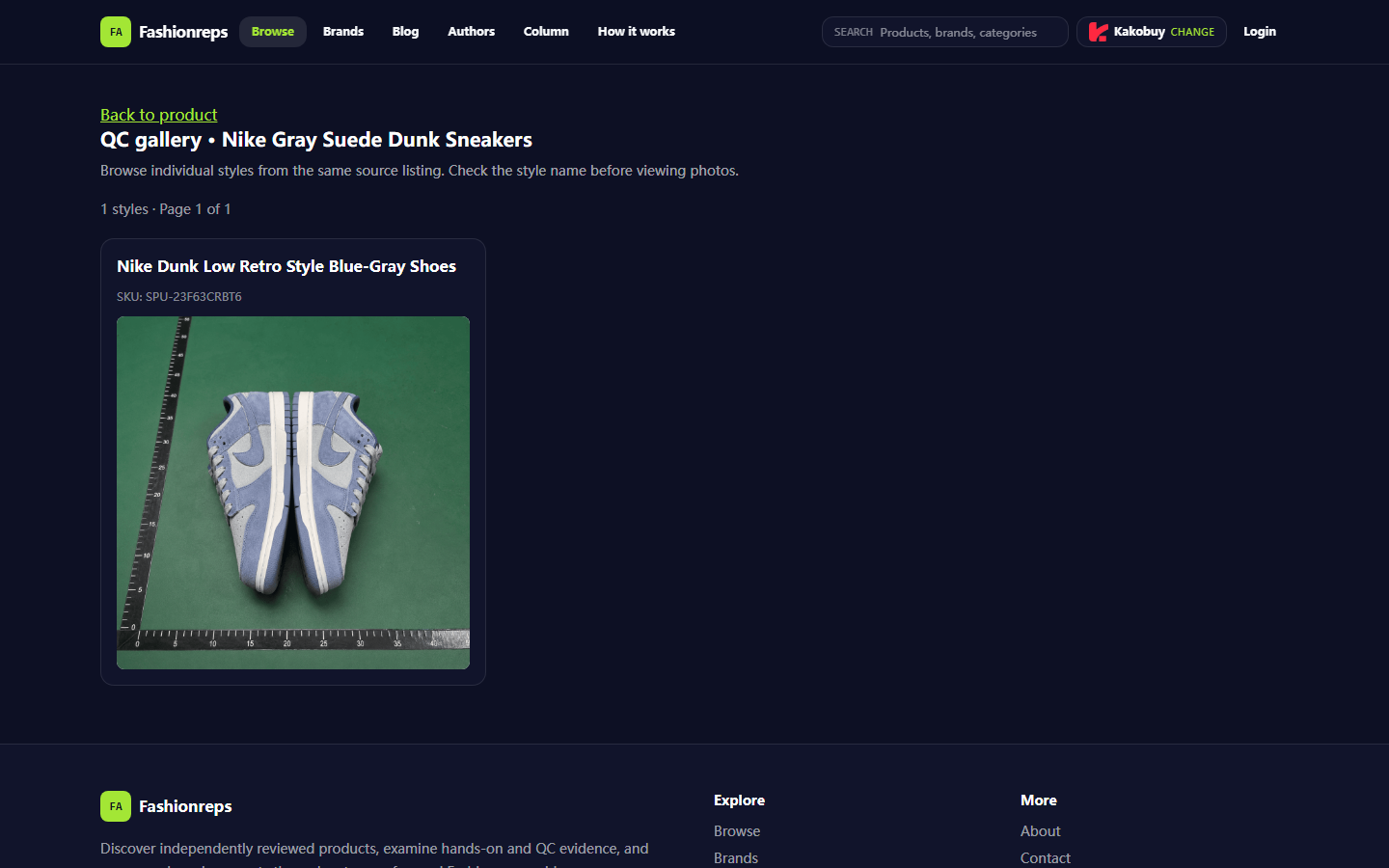
fashion-reps.net is closer to a catalog-browsing product discovery site. Visible navigation includes product browsing, brands, blog, authors, and a search entry; product pages also display specific styles, SKUs, and QC image entries. Taking the visible Nike Gray Suede Dunk Sneakers on the page as an example, the QC page shows one style: Nike Dunk Low Retro Style Blue-Gray Shoes, and lists SKU: SPU-23F63CRBT6.
These fields are good for establishing product identity first, but they can't serve as a complete purchase record. When browsing, check in this order:
- Is the product title clear enough to distinguish different Nike styles?
- Does the page show an SKU or other reference number you can search later?
- Is there a QC photos or QC gallery entry on the page?
- Can the QC page be matched to the same product or specific style?
- Are the images sufficient to observe the upper, sole, toe, heel, and size labels?
- Does the page provide visible size, color, seller, or source fields?
- After clicking the buy button, does it take you to your chosen shopping agent, rather than mistakenly assuming fashion-reps itself completes the order?
The site page clearly states that the buy button redirects to the user-selected shopping agent, and orders, payment, and shipping are handled by the agent's site. Therefore, keep the catalog records from fashion-reps separate from the agent's order records. 🧾
Use Google Sheets to Set Up Columns for Size, Color, and QC Links
Site cards are great for discovering and opening products, while Google Sheets is great for putting multiple candidate items in one view to filter, supplement, and collaborate. It's best to record only one specific product or style per row, not multiple colors and sizes crammed into a single hard-to-filter cell.
Start with these fields:
| Field | How to record | Review purpose |
|---|---|---|
| Product name | Use the visible page name | Distinguish different shoe models |
| Brand | Nike | Filter by brand |
| Style | Record the specific style shown on the page | Avoid mismatching under similar titles |
| SKU | Copy the page number exactly as shown | Trace back to product and QC pages |
| Color | Only fill in colors explicitly shown on the page | Avoid guessing from images |
| Size info | Record what the page shows or mark as missing | Decide if further verification is needed |
| Product page status | Accessible, redirected, 404, or pending review | Identify dead records |
| QC page | Save the page entry or internal location info | Revisit image evidence |
| Image coverage | Toe, side, heel, sole, size tag, etc. | Judge if evidence is sufficient |
| Review date | Enter the last checked date | Identify information freshness |
| Review conclusion | Pending confirmation, can continue comparing, stop | Support next-step decisions |
| Notes | Record doubts and questions to confirm with the agent | Prevent repeated searching |
For the size field, don't just write "sizes available" or "recommend sizing up." If the page doesn't provide a clear size chart, foot length measurement, or insole label info, record it as "no clear data shown," then write the questions to confirm in the notes, such as "need to confirm available size range" and "need to ask about corresponding foot length." This avoids passing off experiential judgment as page fact.
For the color field, also stay restrained. When the page title or details explicitly state a color, record it as is; if you're just judging from images that it's gray-blue, mark it as "image observation, pending page confirmation," and don't treat visual inference as an official product attribute. 🔎
The Order of Operations for Site Card Browsing and Spreadsheet Filtering
Break the work into four stages: discovery, verification, organization, and pre-submission review.
Step one is discovery. Use fashion-reps.net's product browsing, brand entry, or search to locate Nike shoes. At this stage, just record potentially relevant products—don't rush to judge whether they're worth buying.
Step two is verification. Open the product page and confirm the name, style, and SKU. If the page provides a QC gallery, go to that page and check whether the images actually belong to that style. Also record the number of styles displayed on the page, because one source product might include multiple styles, and you can't rely on the overall title to determine image ownership.
Step three is organization. Write the confirmed fields into Google Sheets. Use standardized values for "field status," such as confirmed, not provided on page, needs agent confirmation, and link broken. Standardized values are better for filtering than free-form entries and reduce expression variance in multi-person collaboration.
Step four is pre-submission review. First filter for records marked "confirmed" or "can continue comparing," then open each page one by one. Finally, confirm that the product name, style, SKU, size description, and QC images haven't been mixed up across rows. Don't rely only on old browser tabs, because product pages or QC pages may have changed.
Google Sheets' strength is filtering by brand, color, size status, QC completeness, and review date. It cannot automatically prove that product info is genuine, nor replace re-checking the website pages. The site catalog is better for discovering products and viewing visual evidence; the two serve different purposes, so don't treat the spreadsheet as a permanent copy of page facts.
How to Split Columns for Product Images, Size Info, and QC Evidence
A single image usually supports only limited judgments. Break image evidence into several checkable columns rather than just one "image link" field:
- Does the image show the overall appearance?
- Can you see the toe and side structure?
- Can you see the heel, sole, stitching, and other parts?
- Does it show a size tag, shoebox label, or other identity info?
- Does the image belong to the current style, not a different style from the same source?
- Is the image clear, and is there any obstruction, cropping, or ambiguous area?
If the QC page only shows images without measured foot length, insole length, or size chart, don't treat the images as size evidence. Images can help you pose questions, like "need to confirm the foot length for size 42," but they can't directly lead to a fit conclusion.
Also record the purpose of product images vs. QC images separately. Product main images are for identifying the style, while QC images are for observing the visible condition before shipping. Mixing them will make later review mistakenly treat the main image as the actual order photo. If an image can't prove a certain piece of info, writing "not shown" is more reliable than filling in a guess.
How to Record Broken Links, Missing Fields, and Update Times
Link status is an important part of the review sheet. Both product catalog pages and QC pages may show redirects, empty pages, structural changes, or be inaccessible. Don't delete old records; instead, keep the original URL, last review date, and current status in the sheet.
Use these statuses:
- Accessible: page opens, product identity fields are clear.
- Accessible but insufficient fields: page exists, but missing size, color, or QC needed info.
- QC pending review: product page accessible, but QC page not yet checked for correspondence.
- Redirected: original URL jumps elsewhere, need to confirm if it's still the same product.
- 404 or empty page: temporarily cannot serve as valid product evidence.
- Agent confirmation in progress: site info exists, but order, stock, or available sizes need confirmation from the shopping agent.
Update the date on every review, but don't use the update time to mask missing fields. A page opened today that still has no size chart should still be marked as "insufficient fields." The date indicates when you checked, not that the info itself has been officially confirmed.
If multiple people maintain the sheet, add "last modified by" and "modification reason" to the record. This helps distinguish added products, corrected SKUs, discovered broken links, and supplemented QC notes, avoiding duplicate entries for the same record. ✅
The Appropriate Boundaries Between Site Catalog and Google Sheets
The table below helps decide where information should live:
| Task | Better on fashion-reps.net | Better in Google Sheets |
|---|---|---|
| Discovering Nike shoes | Product browsing, brand entry, search | Save the filtered candidate set |
| Viewing page images | Product page and QC gallery | Record image coverage and doubts |
| Verifying specific styles | Page title, style, and SKU | Compare multiple styles side-by-side |
| Managing size issues | Look up visible page info | Mark missing fields and pending questions |
| Tracking link status | Reopen the original page | Save status, date, and reviewer |
| Team collaboration | Share page access entry | Standardize fields, filter, and comment |
| Orders and shipping | Handled after redirect to shopping agent | Keep only necessary candidate and review records |
Don't treat fashion-reps.net's catalog as an order system, and don't treat old content in Google Sheets as current stock or current prices. The site provides browsable product leads and page evidence; the sheet helps you organize evidence, spot gaps, and schedule reviews. Payment, orders, warehouse QC, consolidation, logistics, and after-sales still need to be verified through the actual shopping agent's process.
Evidence Review Checklist Before Submitting a Candidate
Before submitting a Nike shoe candidate, check these items one by one:
- The product name and specific style are already distinguished.
- The SKU is recorded exactly as on the page, without mixing with other styles.
- The color comes from an explicit field or is marked as image observation.
- Size info is recorded; when missing, what needs confirmation is written down.
- The product page is accessible, or the broken status is clearly noted.
- The QC page actually corresponds to the current product and current style.
- The images support the review questions you're asking, but aren't overstated as physical inspection conclusions.
- Prices, stock, agent, shipping, tax, and return conditions are not replaced by old spreadsheet data.
- Items requiring shopping agent confirmation are listed separately.
- The latest review date and reviewer are filled in.
After completing this checklist, the value of Google Sheets isn't just storing links—it's turning "discovered products" into "reviewable candidates." If the page is missing critical size or QC evidence, the most time-efficient decision is usually not to keep guessing, but to mark it as pending confirmation or temporarily remove it from the candidate set.