 Marcus FeldEditor-in-Chief
Fendi Accessories: Verify Variants and Update Time
Introduction If you are comparing Fendi [accessories](https://fashion-reps.net/accessories) on fashion-reps with product pages from other platforms, the most common mistake is not the price, but mistaking different colors, sizes, material descriptions, or even different product pages for the same item. Page update times also cannot be judged solely by the "Latest" sort, because sort order does not equal the actual update time of product information. This article addresses only one specific task:
Editor score 4.2 / 5
Introduction
If you are comparing Fendi accessories on fashion-reps with product pages from other platforms, the most common mistake is not the price, but mistaking different colors, sizes, material descriptions, or even different product pages for the same item. Page update times also cannot be judged solely by the "Latest" sort, because sort order does not equal the actual update time of product information.
This article addresses only one specific task: before deciding to add a Fendi accessory to your candidate list, how to use visible evidence to verify style variants, source pages, page status, and update times. This article does not confirm authenticity for you, nor does it treat any page description as a completed physical QC. The information displayed on fashion-reps category pages is verified as of October 14, 2026; prices, inventory, images, link status, and page content may change, and you must re-check before submitting an order. 🔎

Clarify the Selection Problem for Cross-Platform Verification of Fendi Accessories
Your selection problem should be written as an actionable sentence:
"Do I have enough evidence to confirm that the fashion-reps page and the other platform page describe the same item, the same variant, and that the page information is still valid?"
After verification, you should be able to complete the following actions:
- Select a traceable fashion-reps product page as a baseline.
- Save corresponding page and seller information for other platforms.
- Distinguish between same-item evidence, similar-item evidence, and items that cannot be determined.
- Record the color, size, material, images, and page status for each variant.
- Decide whether to proceed to the next step of QC verification, continue searching for evidence, or not add to the candidate list for now.
This method does not apply to the following situations:
- Only a cropped image, without product name or variant information.
- The page has been redirected, cannot be opened, shows blank, or only has a collection of tags.
- The price comes from an old screenshot, but there is no corresponding current product page.
- The two platforms use different product images, and there is no common style number, seller information, or specification evidence.
- You need to confirm authenticity, actual leather, real inventory, or physical workmanship, but the page has no verifiable information.
Editor's judgment: If two pages can only prove that they "both look like Fendi accessories," they should be marked as similar items, not the same item. 🙂
Record Style, Color, Size, and Update Time on fashion-reps Product Pages
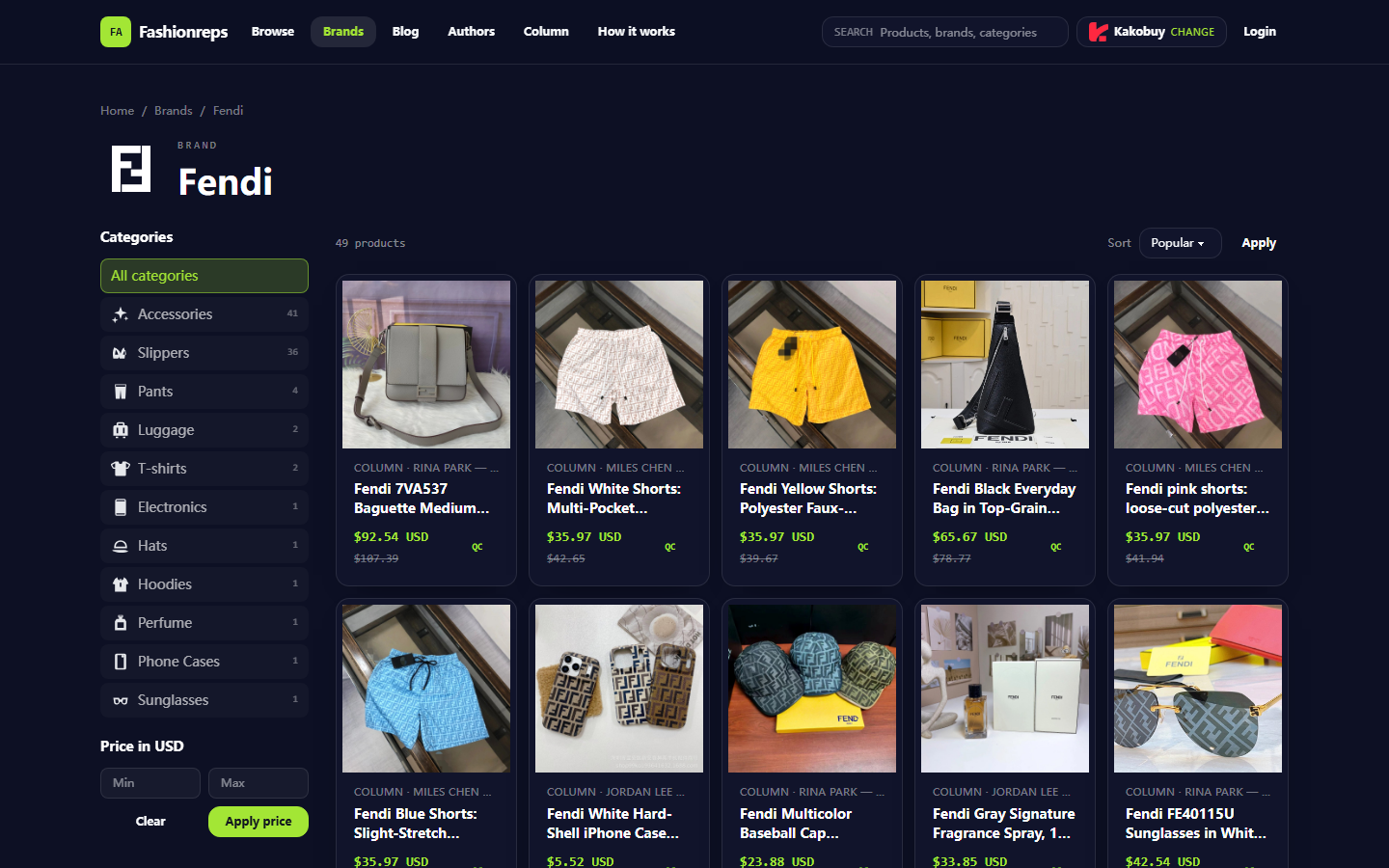
The Fendi brand page on fashion-reps shows 49 products at the time of this check, and provides categories such as Accessories, Slippers, Pants, Luggage, T-shirts, Electronics, Hats, Hoodies, Perfume, Phone Cases, and Sunglasses. The page also provides sorting options such as Popular, Latest, Price: low to high, and Price: high to low.
This information is suitable for establishing a candidate range, but it cannot directly prove that a particular product page has been recently updated. When recording, you should keep "sort position" and "page update time" separate.
It is recommended to record the following fields first:
- Product title: Save the complete currently visible title, not just "Fendi bag" or "Fendi cap".
- Product category: For example, bag, hat, sunglasses, perfume, or phone case.
- Color: Save the original text on the page and your own standardized writing, such as black, gray, or multicolor.
- Size: Record the size range, single size, or whether the page has no size information.
- Material: Only record the description explicitly written on the page, do not infer "leather-like" as genuine leather.
- Style number: If identifiers such as FE40115U, 7VA537 appear in the title, save them as is.
- Current reference price: Record the currency, date, and whether the page also shows an old reference price.
- Page status: Accessible, redirected, empty page, missing product information, or need to further open the detail page.
- Update time evidence: Explicit date on the page, page modification notice, crawl time, or "not displayed".
- Image evidence: Whether the main image, detail images, and images from other platforms can correspond item by item.
Visible examples on the fashion-reps brand page this time include:
- Fendi 7VA537 Baguette Medium Messenger in Gray Lychee-Texture Leather, with a reference price of 92.54 USD and a previous reference price of 107.39 USD.
- Fendi Multicolor Baseball Cap Collection, described as five colorways and adjustable cotton crown, with a reference price of 23.88 USD.
- Fendi FE40115U Sunglasses in White, described as a wide-lens everyday frame, with a reference price of 42.54 USD and a previous reference price of 50.92 USD.
- Fendi Gray Signature Fragrance Spray, showing 100 mL, six scent variants, with a reference price of 33.85 USD.
These are visible descriptions on the page, not independent material identification, inventory commitment, or purchase experience reports.
Establish a Same-Item Identification and Source Record Table for Other Platforms
For other platforms, you cannot just record a URL or screenshot. At a minimum, you need to keep the page title, seller, platform, page status, and verification time. If the platform displays a product release or update time, record that field in its original text; if not, clearly write "not displayed" and do not substitute the access date.
| Verification Field | fashion-reps Baseline Page | Other Platform Page | Editor's Judgment |
|---|---|---|---|
| Product Name and Style Number | Save complete title and visible style number | Save complete title, style number, or seller code | Evidence is stronger when there is a common style number; without one, you cannot identify the same item based on brand name alone |
| Color and Variant | Record current visible color on page | Record currently selectable colors on seller page | Different color names but same images can only be marked as pending verification |
| Size and Specifications | Record size range or not displayed | Record size chart, capacity, or specifications | Different size ranges may represent different variants or batches |
| Images and Details | Save main image and key details | Save corresponding angles and details | Similar composition alone is not enough to prove same item |
| Page Update Time | Record explicit date or not displayed | Record explicit date or not displayed | Access date is not the page update time |
| Link Status and Visible Information | Accessible with product information | Accessible with product information | Redirects, empty pages, or pure tag pages do not count as valid evidence |
If you use spreadsheet software, it is recommended to keep a separate row for each platform, rather than merging multiple pages under one product name. This prevents an old price from one platform and a new color from another platform from being incorrectly concatenated into the same record.
Source records should also include:
- Time when the page was first discovered and last verified.
- Whether the page requires login to see complete variants.
- Whether the page shows current price, reference price, or historical price.
- Whether images are from the seller, platform catalog, or user uploads.
- Whether you actually opened the detail page, or only saw the brand aggregation page.
Compare by Image, Specifications, Variants, and Link Status Item by Item
Same-item verification should be done in a fixed order to avoid looking for supporting evidence after seeing a low price first.
The first step is to compare product identity. Prioritize looking for style number, model, series name, or seller product code. When identifiers such as 7VA537 and FE40115U appear on fashion-reps pages, save them as separate fields. Without a common identifier, product names can only serve as preliminary clues.
The second step is to compare appearance structure. Check whether the images simultaneously show the same:
- Logo position and proportion.
- Outline of the bag body, frame, crown, or bottle.
- Hardware, temples, straps, buckles, or cap details.
- Stitching, splicing, print, and pattern direction.
- Color and lighting conditions in the images.
Similar images do not mean the same structure. For hats, glasses, and small accessories in particular, small changes in main image angle can hide differences in size or accessories.
The third step is to compare specifications. List colors, sizes, capacities, material descriptions, and number of variants side by side. For example, if one page says "six scent variants" and another page only shows one scent, they cannot be directly considered the same group of products; if one page shows sizes S to 6XL, you cannot infer that a single-size product on another page has the same size range.
The fourth step is to compare page status. Confirm whether the page:
- Can still open product details.
- Displays a clear product name.
- Shows images and specifications sufficient to support judgment.
- Allows viewing current variant selections.
- Does not redirect to the brand homepage or blank page.
- Does not only show category tags without product information.
The fifth step is to compare prices. Price differences can help discover different variants, different sellers, or historical pages, but price itself does not prove the same item. The reference price and previous reference price shown on fashion-reps pages should also be saved separately; do not write them as a current discount commitment. 💰
How to Verify Page Update Date and Current Visible Inventory Information
Page update dates require separate evidence. You can check:
- Whether the product detail page shows a release date, modification date, or inventory update time.
- Whether page source information or visible update notices provide a date.
- Whether price, inventory, or images change after selecting a variant.
- Whether the page still shows the same title, style number, and same set of images.
- Whether previously recorded content still exists after reopening the page.
If the page has no explicit update time, write "No update time displayed, last verified on October 14, 2026." Do not write the last access date as the platform's update time.
Inventory information should also be expressed cautiously. The following situations only indicate that the page currently has visible options, not that the warehouse definitely has stock:
- The page still shows a purchase button.
- Dropdown menus still show colors or sizes.
- The page shows a price but no inventory label.
- The aggregation page still lists the product.
Only when the page explicitly shows inventory status, or when the next purchase step explicitly returns an purchasable status, can you record the corresponding fact; even then, you should note the verification time and applicable variant. A page showing "selectable" does not mean all colors, sizes, and seller inventory are available.
How to Mark Uncertain Items When Lacking Same-Item Evidence
Do not force a conclusion just to complete the comparison. It is recommended to use the following three labels:
- Confirmed same item: Style number or explicit specifications match, image details match, and variant and page status correspond.
- Highly similar but unconfirmed: Names, appearance, or partial specifications are similar, but lacking common style number, complete images, or update time evidence.
- Cannot be determined: Page cannot be opened, information incomplete, images inconsistent, or key variants missing.
For each uncertain item, explain the gap, for example:
- "Color names are the same, but lacking detail images from the same angle."
- "Product titles are similar, but no common style number found."
- "Page has price, but no visible update time."
- "Brand page still visible, but detail page status not yet confirmed."
- "Other platform only shows a single variant, cannot correspond to the entire group of products."
This method of recording is more useful than writing "should be the same item," because the next step can ask questions or continue verification based on missing evidence. 🧾
Decide Whether to Proceed to Next Step QC Verification Based Solely on Visible Information
The criterion for entering the QC candidate list should not be "lowest price" or "best looking images," but whether the information is sufficient for the next step of verification to have a clear goal.
Situations where you can proceed to the next step QC verification include:
- At least one accessible product detail page.
- Product name, category, and key variants have been recorded.
- Images contain structure or details that can be compared in QC.
- Colors, sizes, or capacities are clear, or missing items are noted.
- Page status and last verification date have been saved.
- You know what to check next, such as logo position, frame width, hat circumference, hardware, or packaging information.
Situations where you should not proceed to QC yet include:
- Can only judge from brand aggregation page, without opening detail page.
- Other platform page is invalid or redirected.
- Target variant is not consistent between the two platforms.
- Key images are suspected to be from different products, without source explanation.
- Page update time and current inventory cannot be verified, and your purchase decision relies heavily on time-sensitive information.
QC can only verify the specific items you raise; it cannot automatically upgrade page information to material identification, authenticity guarantee, or complete after-sales commitment. For highly volatile information, re-verify once more before submitting an order.
Final Actions Before Adding Fendi Accessories to Candidate List
Before submitting candidates, complete a short final checklist:
- Have you saved the complete title and detail page status of the fashion-reps page?
- Have you saved the page title, seller, and verification date for other platforms?
- Have you compared colors, sizes, capacities, material descriptions, and images item by item?
- Have you recorded page update time separately from access date?
- Have you marked inventory, update time, and style number information that is not displayed?
- Have you separated "confirmed same item," "highly similar but unconfirmed," and "cannot be determined"?
- Have you specified the exact details to check in the next QC step?
- Have you re-confirmed price, variant, inventory, shipping, taxes, and after-sales terms before submitting the order?
Final decisions can be written as three outcomes:
- Add to candidate: Evidence is sufficient, proceed to next step QC, but this does not mean physical quality has been confirmed.
- Hold: There is some similar evidence, but need to supplement style number, images, specifications, or page update time.
- Exclude: Page invalid, information conflict, or key variants cannot be confirmed.
This method saves not a fixed amount of money, but reduces rework costs caused by mistakenly identifying the same item, choosing the wrong variant, or ordering based on outdated pages. It is more suitable for buyers who compare multiple product pages simultaneously and value traceable records; it is not suitable for those who treat web page information as authenticity appraisal or physical guarantee. Without sufficient same-item evidence, holding off on adding to the candidate list is usually safer than ordering immediately based on the lowest price.