 Marcus FeldEditor-in-Chief
Supreme Spreadsheet vs Google Sheets for Hoodies
The goal of this organization isn't to copy every product you see into a spreadsheet, but to build a reviewable list of candidates: first discover [Supreme hoodies](https://fashion-reps.net/hoodies/supreme) in [fashionreps](https://fashion-reps.net/)' website-style product catalog, then use Google Sheets to consistently record images, sizes, colors, product links, and QC entry points, and finally go back to the product page to check that each item still matches. This reduces image mix-ups, link
Editor score 4.2 / 5
The goal of this organization isn't to copy every product you see into a spreadsheet, but to build a reviewable list of candidates: first discover Supreme hoodies in fashionreps' website-style product catalog, then use Google Sheets to consistently record images, sizes, colors, product links, and QC entry points, and finally go back to the product page to check that each item still matches. This reduces image mix-ups, link mismatches, and missed size information. 🔎
This article is for those who are organizing multiple hoodie candidates, need to share lists with colleagues, or are preparing to further open product pages for verification. It's not for those who treat the spreadsheet as a guarantee of inventory, price, authenticity, or final purchase; these details should still be based on the current product page and subsequent shopping agent pages.

What This Supreme Hoodie Organization Aims to Accomplish
A proper organization should at least allow the next viewer to answer four questions:
- Which hoodie does this row correspond to?
- Does the current image really belong to this product, and not another style on the same page?
- Does the product page provide size, color, or other specification information?
- After clicking the product link, can you return to the corresponding page and continue viewing QC or purchase paths?
It's recommended to first determine the record status before deciding whether to proceed. Status can use simple values like "candidate," "pending fields," "pending page review," "completed review," and "link broken." Don't treat blank fields as "non-existent," because they may simply mean not yet checked.
How to Discover Hoodie Candidates in fashionreps' Website-Style Spreadsheet
fashionreps' visible catalog is suitable for "discovery" and "returning to the product page for review." The page navigation includes product browsing, brand categories, search, and product detail entry points; product detail pages may also provide QC galleries or multiple styles from the same source. The shopping agent selector on the website is for continuing to external agent processes, and should not be interpreted as proof of inventory or price for the product itself.
When discovering candidates, it's recommended to follow this order:
- First search using Supreme combined with hoodie, sweatshirt, or specific style terms.
- Open the candidate product page and confirm the product name displayed, not just the thumbnail text in search results.
- Check that the image matches the product name and style description.
- Record the product page URL, page title, visible colors, and size information.
- If a QC entry exists on the page, record the QC page or entry location separately, and don't mistake QC image URLs for product purchase links.
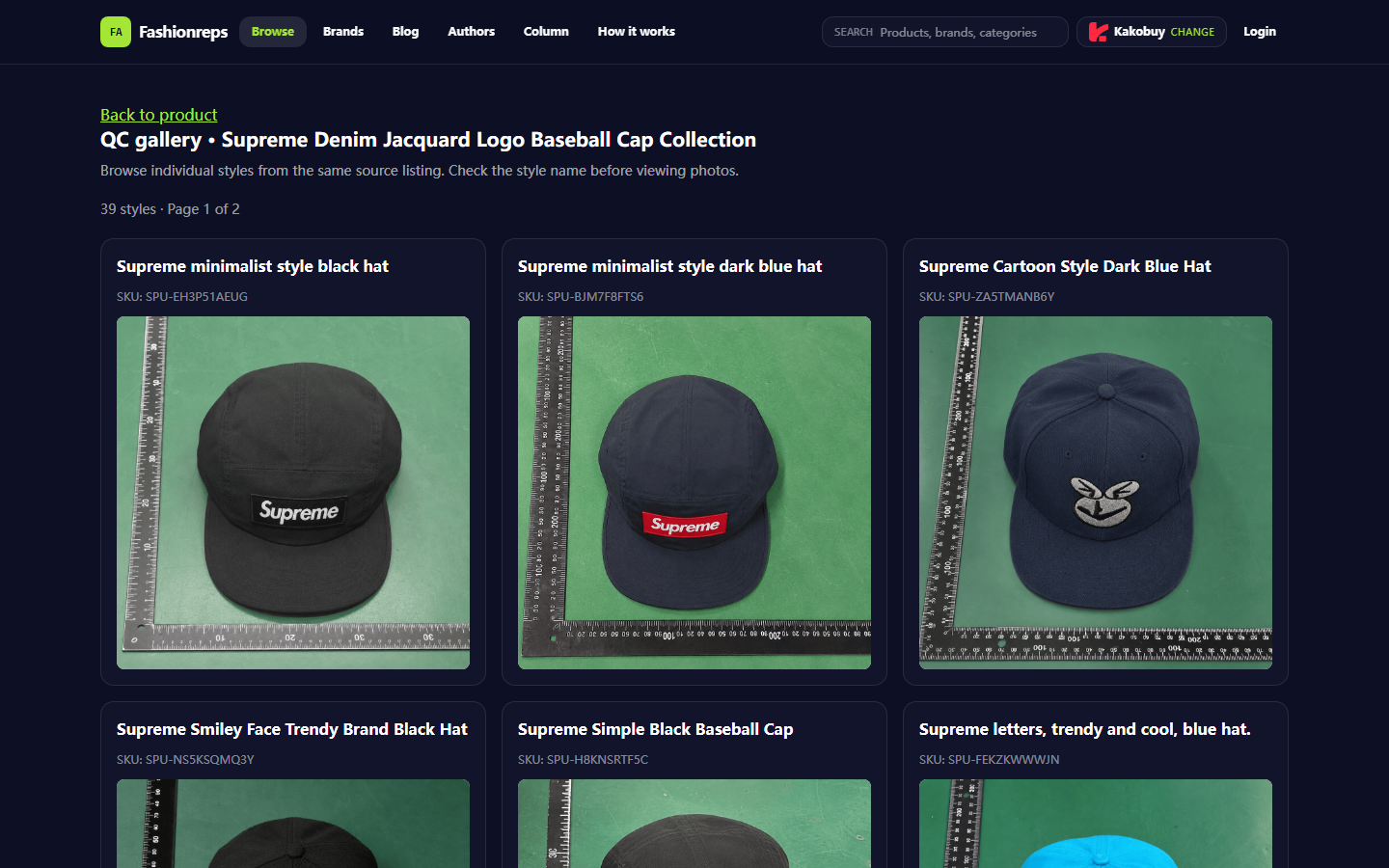
The same source may contain multiple styles. The product page example visible in the screenshot includes multiple Supreme caps and different SKUs, indicating that the same source page may have multiple variants or related styles. When organizing hoodies, you should confirm the currently opened style item by item, and not reuse images, SKUs, or QC records from the previous row just because the brand name is the same. 🧭
How to Set Up Size, Color, Image, and Link Columns in Google Sheets
Google Sheets is better for structured recording, filtering, and collaboration. Column names should directly serve the verification action, avoiding a single "notes" column that mixes all evidence together.
Recommended fields:
| Field | Content to Record | Verification Focus |
|---|---|---|
| Product Name | Name displayed on product page | Consistent with current page title |
| Brand & Category | Supreme, hoodie, etc. | For filtering, not a substitute for product name |
| Color | Color explicitly displayed on page | Don't guess color from thumbnails |
| Size Information | Sizes listed on page or status of size chart | Distinguish "provided," "not found," "pending page" |
| Main Image URL | Image address or image record for the product | Image must match the current style |
| Product Link | URL back to product detail page | Don't fill in QC image URL |
| QC Entry | QC page or entry record | Keep separate from purchase link |
| Verification Status | Candidate, pending review, verified, broken | For later filtering |
| Verification Date | Date of last review | Prevent old info being treated as current |
If multiple people are collaborating, consider adding "who is responsible for review," "last modified time," and "issue description" to the sheet. Don't have collaborators directly overwrite the original product link; the safer approach is to keep the original value and record new verification results in the status or notes column.
The size field especially requires caution. When the page doesn't show a size chart, record "no size chart seen" instead of filling in chest width, length, or recommended height based on common sizing habits. Color should also be based primarily on page text; images are only auxiliary observations, and you can't treat lighting, monitor color differences, or compression effects as official specifications. 📏
How to Verify Product Card and Spreadsheet Row Data Item by Item
For each new row, you can verify in the fixed order of "name, image, specifications, link, entry." A fixed order makes it easier to spot field misalignment.
First, look at the name. The name in the spreadsheet should come from the current product page, not from adjacent cards or search summaries. Second, look at the image to confirm that the pattern, color, and style displayed match the name. Third, check specifications: verify that color, size, and material fields actually appear on the page. Fourth, open the product link to confirm the link still works and doesn't jump to an unrelated product. Fifth, check the QC entry to confirm it belongs to the same product or the same source style.
You can add a "verification basis" field in the sheet, such as "product page title," "detail specs section," "QC entry," "image matches name." This is more useful than writing "confirmed," because others can know exactly what was looked at.
If the product page contains multiple similar styles, it's recommended to use one row per style, not compress multiple colors or patterns into one record. Only when the page explicitly lists them as selectable variants of the same product can you record variants in the same row; otherwise images, sizes, and links will easily contaminate each other.
How to Record Image Evidence, Product Specs, and QC Entries Separately
The three types of information serve different purposes:
- Image evidence is used to confirm the style and visual details displayed on the page.
- Product specs are used to record colors, sizes, materials, or other fields explicitly provided on the page.
- QC entries are used to continue viewing quality inspection related images or page content.
They cannot replace each other. Seeing an image does not mean you have obtained complete size information; seeing a QC entry does not mean the QC images necessarily cover all details; having a color written on the product page does not mean every attached image belongs to that color.
If you need to save images, it's recommended to also keep the image source, purpose, corresponding product row, and verification date. Image file names can include product identification information, but don't rely solely on file names to judge ownership. For publicly posted images, you should also confirm the source and usage rights; without clear basis, prioritize text records instead of copying images with unclear rights.
QC images should be described as QC evidence or inspection entries provided by the page, not written as personal inspection, fabric touch, or confirmed quality. The visible content of the website page can only support page-level observations. 🧵
How to Preserve Pending Verification Status When Links Are Broken or Fields Are Missing
When encountering broken links, page redirects, image loading failures, or missing fields, don't delete the entire row and don't fill in speculative content. Keep the original record, change the status to "pending verification" or "link broken," and note the last check date and specific issue.
Recommended handling:
- Product page won't open: keep the original link, record access failure, don't rewrite to a new unknown link.
- Image can't be confirmed: leave the main image field blank or mark as pending, don't copy images from adjacent products.
- No size chart: record that no size chart is visible on the page, don't calculate or infer sizes yourself.
- QC entry missing: mark QC status as not found, don't treat regular product images as QC evidence.
- Page shows multiple styles: split records until name, image, and link correspond one-to-one.
Google Sheets' filter feature can quickly find these pending rows, but filter results don't equal factual conclusions. After completing verification, change the status to "verified" and update the verification date; if the page changes later, reopen the page instead of just continuing with old records. ⏳
When Website Browsing and Spreadsheet Organization Are Each Suitable
The two are not tools that replace each other. fashionreps' website catalog is better for discovering products, viewing product cards, opening detail pages, and finding QC entries; Google Sheets is better for comparing multiple candidates side by side, filtering missing fields, assigning collaboration tasks, and saving verification status.
| Work Scenario | Better for Website Catalog | Better for Google Sheets |
|---|---|---|
| Discovering new candidates | Browsing, searching, brand or category entry | Recording candidate names and sources |
| Viewing a single product | Product detail page, images, and QC entry | Saving verification results |
| Comparing multiple candidates | Need to open page by page | Filtering colors, sizes, and status |
| Multi-person collaboration | Viewing current page | Assigning owners and updating status |
| Handling exceptions | Judging page accessibility | Keeping issues, dates, and follow-up actions |
Don't claim one tool is always faster unless you have repeatable measurement records. Actual efficiency depends on page load, link status, number of candidates, and collaborators' familiarity. A more reliable judgment is: the website provides page evidence, the spreadsheet stores structured judgments.
Final Checklist from Candidate Sheet Back to Product Page
Before submitting candidates, complete the following checks row by row:
- Product name matches current page title.
- Category labels like Supreme and hoodie are not mistakenly applied to other products.
- Image belongs to the current style, not an adjacent style on the same page.
- Color comes from visible page information, not subjective guessing from images.
- Size field clearly distinguishes provided, not found, and pending verification.
- Product link leads back to the corresponding product page.
- QC entry is recorded separately from product link.
- When page fails to open or fields are missing, status remains pending verification.
- Verification date is filled in.
- Image observations are not written as personal try-on, inspection, or receipt experience.
The final back-to-page check is important because the sheet may store old links, and pages may display different content at different times. When it involves price, inventory, shipping, taxes, or purchase agent selection, you should separately check the current page and destination country's applicable conditions, and cannot directly derive final cost from this organization sheet.
How to Decide Whether to Submit Links Next
Only when product name, image, specification status, and product link correspond, and abnormal fields are clearly marked, is it appropriate to submit the link to the next collaborator or proceed to the subsequent purchase process. Before submitting, you can filter the sheet to "verified" while keeping "pending verification" records, to avoid mistaking incomplete candidates for directly usable links.
If the ultimate goal is just to compare Supreme hoodies, prioritize submitting a small number of candidates with complete evidence, rather than submitting many rows that lack size or image correspondence. The value of submitting is to reduce duplicate checks for the next person; a link that can't return to the correct product page, even if the name looks complete, should not be considered done.
This organization method mainly saves time on repeated opening, repeated copying, and collaborative communication; it adds workload for sheet maintenance, page re-verification, and status updates. It's suitable for those who need to manage multiple candidates, value traceable records, or collaborate with others. It's not suitable for those who only want to quickly order based on images, cannot further verify pages, or want to use the spreadsheet to replace product pages, size charts, and QC evidence.