 Marcus FeldEditor-in-Chief
Organizing Acne Studios Accessory Candidates: Spreadsheets
# Organizing Acne Studios Accessory Candidates: Spreadsheets  ## First, Define the Goal for Organizing acne studios Accessory Candidates If your goal is to narrow down a few items worth further verification from [acne studios](https://fashion-reps.net/brand/acne-studios) accessory candidates, the most important thing is not to build a complex s
Editor score 4.2 / 5
Organizing Acne Studios Accessory Candidates: Spreadsheets

First, Define the Goal for Organizing acne studios Accessory Candidates
If your goal is to narrow down a few items worth further verification from acne studios accessory candidates, the most important thing is not to build a complex spreadsheet right away, but to distinguish two actions: discovering candidates and maintaining candidate information long-term.
fashion-reps' brand catalog is suitable for first browsing product cards, categories, images, and reference prices to judge which items are worth recording. Google Sheets is more suitable for saving your own screening results, adding specifications, recording source status, and arranging the next verification steps.
The specific problem this guide solves is: how to organize candidate products from the website catalog into a reviewable list. After reading, you should be able to:
- Find candidate entries related to acne studios in the catalog
- Record product names, categories, reference prices, images, and page status
- Use Google Sheets to mark items as pending review, verified, or expired
- Check whether product information is still sufficiently complete before ordering
This method is not applicable to treating reference prices in the catalog as final transaction prices, nor to judging brand authenticity, inventory, size fit, or logistics costs based on them. Page information needs to be re-verified when preparing to order. Page functions and catalog content are recorded as of October 8, 2026.
Discover Candidates by Category and Image in the fashionreps Spreadsheet
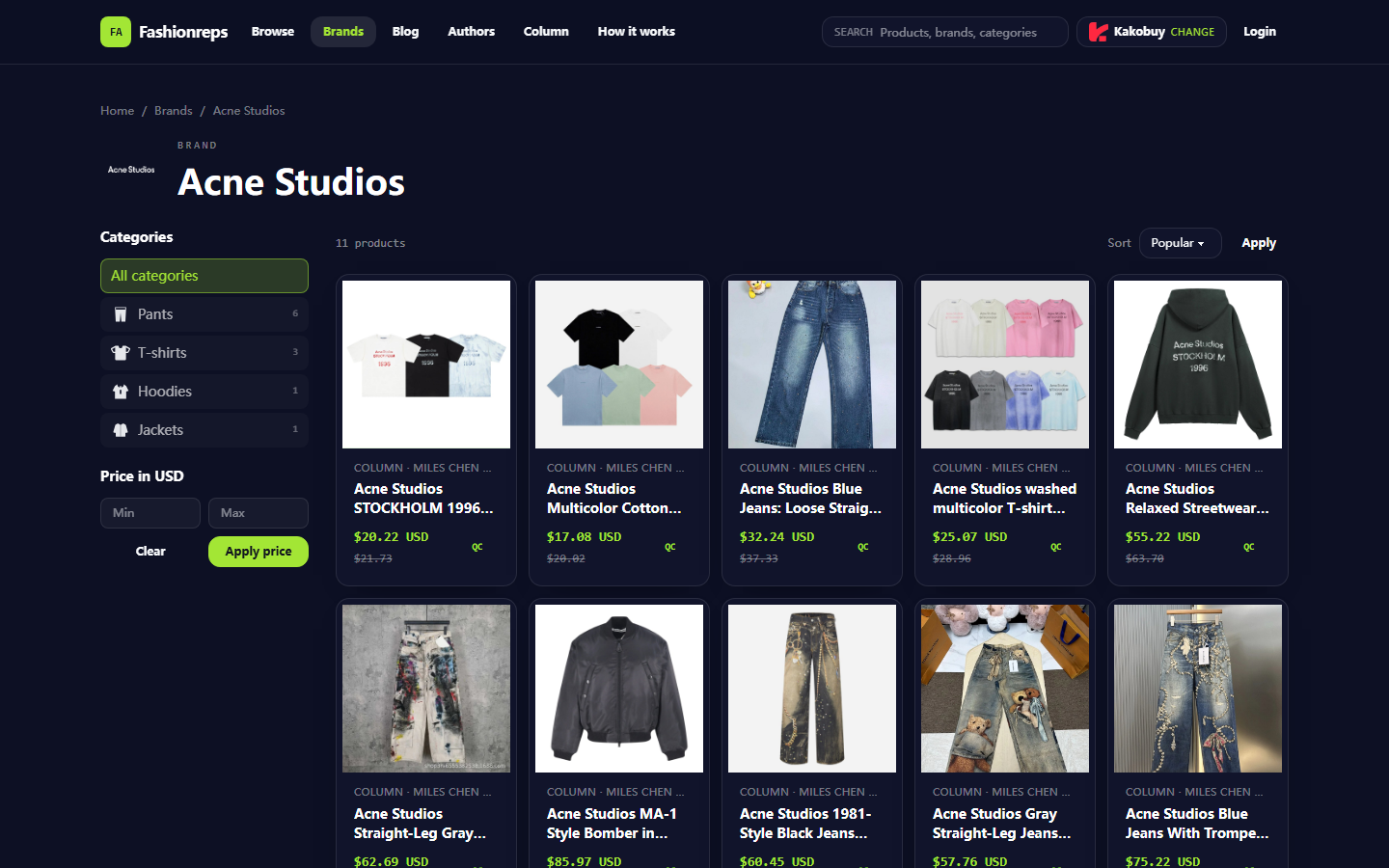
The Acne Studios brand page on fashion-reps provides a brand filter entry and displays categories, price filters, and sorting options. The currently visible categories include Pants, T-shirts, Hoodies, and Jackets, with a total of 11 product entries.
It is important to note that the current visible catalog does not show an Accessories category. The page title can be used for organizing acne studios accessory candidates, but it cannot be concluded that the page already provides hats, scarves, glasses, jewelry, or other accessory items. If your goal is accessories, the first step is to confirm whether the catalog has corresponding categories or clear product names, rather than rewriting clothing entries as accessories.
When browsing, proceed in the following order:
- Enter the Acne Studios brand catalog and first confirm the current page's categories and total number of products.
- Use category, price, or sorting functions to narrow the browsing range.
- Open product cards to check if the full title, image, reference price, and QC marks are visible.
- Only add entries with clear names, accessible pages, and sufficient information for further verification to the candidate list.
- For entries with only vague titles, blank images, or that cannot be opened further, mark them as pending additional information.
Images in the catalog are suitable for helping you identify candidates and distinguish styles, but they cannot alone prove material, size, inventory, or product status. When the image content is inconsistent with the page text, mark the entry as conflicting rather than guessing.
Use Google Sheets to Record Specifications, Links, and Update Times
The website catalog solves "what candidates exist," while Google Sheets solves "why I keep this candidate and what to verify next." It is recommended to record one product candidate per row and keep a stable page record for the same product.
Recommended fields include:
- Product name: keep the full title from the page
- Brand: fill in Acne Studios to avoid confusion with other brands
- Category: e.g., T-shirts, Pants, Hoodies, or Jackets; if it's an accessory, must have page evidence before filling
- Catalog reference price: note that this is a page reference price, not the final cost
- Product page URL: save the original product page URL, not just the search result URL
- Image status: has image, incomplete image, or no image
- QC status: whether the page shows QC-related entry points or marks
- Page status: accessible, redirect, 404, empty page, or pending review
- Last verification date: record the date you most recently opened the page
- Pending verification items: e.g., size, material, color, inventory, or seller information
- Ordering decision: keep, defer, or exclude
The advantage of Google Sheets is not to redisplay products from the website catalog, but to save your own judgment process. You can use filters to view only entries where "page is accessible and pending verification items are empty," or sort by last verification date to find candidates that have not been updated for a long time.
If multiple people are organizing together, it is recommended to separate "factual fields" from "personal judgments." Product name, page status, and reference price are facts that need to be verified against the source; "looks worth buying" or "might suit a certain outfit" are subjective notes and should not be mixed in factual fields.
How to Cross-Check Images, Sources, and Notes for the Same Product
The same candidate product may have varying degrees of information in catalog cards, product detail pages, and personal screenshots. When cross-checking, the currently accessible product page should be the primary source, the catalog card as the discovery entry, and personal screenshots only as historical records.
Check in the following order:
- Are the product titles consistent, or just different in sorting or capitalization?
- Do the images correspond to the same product, not other styles under the same brand?
- Does the reference price include any old price or discount notes?
- Can the product page still be opened?
- Does the page show a clear category and sufficient specification information?
- Does the QC mark belong to this product, not a uniform section on the page?
- Do notes in Google Sheets include the verification date?
If the image still exists but the product page is invalid, do not use the image as current product evidence. You can keep the image record and change the page status to "pending review." If screenshots contain order numbers, shipping addresses, phone numbers, payment information, or complete shipping labels, cover personal information before saving or sharing.
Scenarios Suitable for Quick Discovery vs Long-Term Maintenance
The fashion-reps catalog is more suitable for quick discovery: you can enter the candidate set from the brand page and then perform initial screening through categories, sorting, price, and images. Its value is in reducing the time to find pages from scratch, but the fields displayed in the catalog are still limited and cannot replace complete verification before ordering.
Google Sheets is more suitable for long-term maintenance: it can save multiple verification results, add responsible person, status, date, and to-do items, and is convenient for multi-person collaboration. It does not automatically prove that product information is true and valid; every fact in the table still needs to be confirmed against the source page.
| Organizing Task | fashion-reps Catalog | Google Sheets |
|---|---|---|
| Discovering candidates | Suitable for browsing by brand, category, images, and sorting | Suitable for saving already selected candidates |
| Viewing page information | Suitable for viewing product titles, reference prices, and visible marks | Requires manual recording or supplementary source fields |
| Filtering and sorting | Suitable for initial filtering within the catalog | Suitable for organizing by status, date, and to-do items |
| Collaborative maintenance | Mainly relies on the current website page | Suitable for division of labor, annotations, and status updates |
| Tracking invalid links | Requires reopening the page to confirm | Can record expiration date and review results |
| Pre-order verification | Provides discovery entry | Provides verification checklist, but cannot replace the product page |
Therefore, the more prudent approach is to first use the catalog for discovery, then use Google Sheets for maintenance, rather than duplicating complete product information in both places. This reduces redundant data entry and clarifies which information comes from the website and which is just personal judgment. 🧭
How to Handle Broken Links, Missing Information, and Pending Screenshots
It is best to set unified page statuses in the candidate list to avoid different people recording the same issue with different terms. You can use the following statuses:
- Accessible: product page can be opened, title and basic information clear
- Insufficient information: page opens, but lacks fields needed for further judgment
- Pending screenshot: need to supplement image or partial page evidence
- Broken link: page returns 404, empty page, or inaccessible
- Redirect pending review: address jumps to another page, not yet confirmed whether it is the same product
- Excluded: after verification, no longer meets current filtering criteria
When information is missing, first write clearly what is missing, do not fill in with speculation. For example, "missing material description" is more useful than "maybe cotton"; "no accessory category seen" is more accurate than "website has no accessories" because the catalog may change over time.
After a link is broken, you can keep the original URL, the last successful access date, and existing images, but do not continue to list the entry as a currently purchasable candidate. If you find a suspected new page, create a new verification record and note its relationship to the old page, rather than directly overwriting the old record.
If you need to add screenshots, they should only show page areas that support the current judgment and cover personal information. Screenshots cannot replace accessible source pages, nor can they hide prices, status, or other content that would affect judgment by cropping. 📌
What Verifiable Fields Should a Comparison Table Record
To make the table truly helpful for pre-order verification, fields should be designed around verifiable facts, not stacked adjectives. At minimum, it should include product name, category, page URL, reference price, image status, page status, and last verification date.
If you are preparing to compare multiple candidates, you can add:
- Visible color or style information
- Whether the page provides size information
- Whether the page shows material information
- Whether there are QC images or related marks
- Whether seller or source information is recorded
- Whether further confirmation with the shopping agent is needed
- Current decision and exclusion reason
Reference prices must include currency and verification date. They do not include shopping agent service fees, domestic shipping, international shipping, taxes, insurance, or other possible costs. Do not calculate a so-called final landed price in the table without cost comparison evidence.
Similarly, QC marks only represent the existence of related entry points or signs on the page, not an independent quality appraisal. Size information only indicates what data the page provides, not a guarantee that actual dimensions match expectations. ✅
Final Steps Before Moving from Candidate List to Pre-Order Verification
When the candidate list is organized, decide whether to proceed in the following order:
- Reopen the product page and confirm the link is still valid.
- Verify product name, category, image, and reference price against the table.
- Fill in fields not yet confirmed, such as size, material, color, inventory, and seller.
- Confirm the actual orderable status and current costs through your chosen shopping agent.
- Assess destination country's shipping costs, taxes, import restrictions, and return/exchange conditions.
- Save as a pending order item only when key information is sufficiently clear.
fashion-reps pages provide product discovery and comparison entries, while orders, payments, and shipping are usually handled by the external shopping agent you choose. Before ordering, reconfirm the product address, purchasable status, costs, service terms, and after-sales window on the agent's page. Do not treat the catalog reference price as the payment amount, and do not infer product quality, brand authenticity, or final fit based solely on an image or QC mark.
If your goal is to quickly find a few acne studios candidates, directly using the brand catalog for initial screening is sufficient; if you need multi-person collaboration, ongoing updates, or regular cleanup of broken links, then put the filtered entries into Google Sheets. If the page does not have clear accessory categories or product information, it is not recommended to classify clothing entries as accessories just to fill the table. This reduces misclassification and makes the next verification faster and more accurate. 🗂️
Common Questions About Shopping on Agent Platforms
1. Which shopping platform on hipobuy-sheet.com offers the most cost-effective coupons?
It is recommended to choose Kakobuy, as it currently offers a $15 discount code with no minimum spending requirement. This is a great deal for users ordering small packages. The coupon code is kakobuy888.