 Marcus FeldEditor-in-Chief
Moncler Hat Overseas: Verify Parcel Volume and Freight Cost
 This type of parcel is most prone to misjudgment when you only look at the hat's product price, without putting service fees, payment fees, packaging, volumetric weight, exchange rates, and destination-country taxes on the same verification record. This article focuses on the [Moncler](https://fashion-reps.net/brand/moncler) hat scenario on the [Fashionreps](https://fashion-reps.n
Editor score 4.2 / 5

This type of parcel is most prone to misjudgment when you only look at the hat's product price, without putting service fees, payment fees, packaging, volumetric weight, exchange rates, and destination-country taxes on the same verification record. This article focuses on the Moncler hat scenario on the Fashionreps page, helping you confirm what data you need to input, which fees are already determined, and which fees still can only be based on the logistics calculator or the agent's final quote before submitting overseas shipping.
The date of this record is October 21, 2026. The information provided currently does not include verifiable real-time logistics quotes, specific destination, package weight, dimensions, or tax results, so no specific amounts are fabricated. Before actual shipping, you should re-query using the same destination and the same package conditions.
Clarify the fee verification task for Moncler hats shipped overseas
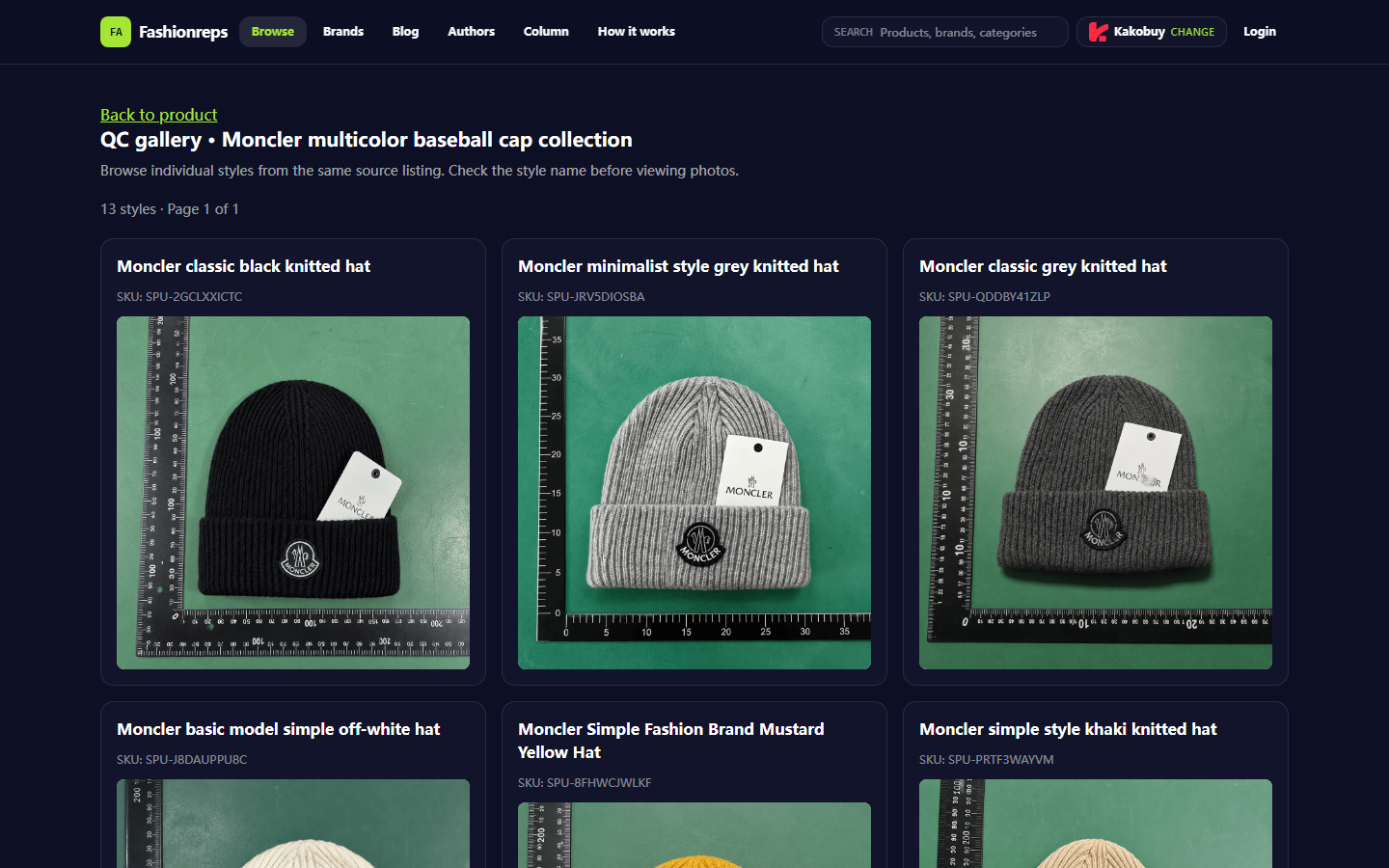
The object of this verification is not a generalized "hat shipping cost," but the product scenario displayed on the Moncler hat related pages on Fashionreps. The QC page shows that this source list includes multiple styles, such as black knit hats, gray knit hats, off-white hats, dark green hats, and other color styles, listing 13 styles in total. Different styles, quantities, and packaging methods may affect the final package information, so you cannot infer shipping costs solely from the brand name or product title.
After completing the verification, you should be able to answer four questions:
- What are the specific style, color, and quantity selected.
- How are product costs, service fees, payment fees, and packaging fees recorded separately.
- Whether the package dimensions, actual weight, and chargeable weight change after keeping or removing packaging.
- To which destination, route, point in time, and tax conditions the logistics calculator quote applies.
If you have not yet determined the destination, quantity, or route, you should not treat the calculator result as the final shipping cost.
Confirm style, color, quantity, and current link from the Fashionreps product page
First, record the complete name displayed on the product page, the style or color, the quantity, and whether the page is still accessible. Do not record just the abbreviation "Moncler hat," because the same source list contains multiple styles, and the QC page also requires confirming the specific style name before viewing photos.
It is recommended to keep the following check items:
- Product title or style name
- Color and size information, if provided on the page
- Purchase quantity
- Current status of the product page or QC page
- SKU or other product identification information displayed on the page
- Query date and platform identity used
The positioning of the Fashionreps page is to help users discover products, view source information and QC images, and guide users to external shopping agents to handle orders, payments, and logistics. The page itself is not equivalent to the final logistics quote, nor can it replace the real-time fee confirmation on the agent's order page.
Record product currency, payment fees, and packaging options
Fee records should be separated by source, rather than merging all numbers into one "total price." If the page or agent does not clearly display a certain fee, mark it as "not provided" or "to be confirmed," and do not fill it in with empirical values.
| Fee Item | Facts to Record | Current Information Status |
|---|---|---|
| Product Cost | Currency, unit price, quantity, and subtotal shown on the product page | No specific value provided; need to verify on current product or agent page |
| Service Fee | Service fee charged by the agent and applicable rules | No specific value provided; need to verify on order page |
| Payment Fee | Payment method, handling fee, currency exchange, or payment surcharge | No specific value provided; need to verify according to actual payment method |
| Packaging Fee | Reinforcement, repacking, removal of outer packaging, or other packaging services | No specific value provided; need to confirm with agent or warehouse page |
| International Shipping | Route, destination, chargeable weight, and quote time | No real-time quote provided; must re-query using calculator |
| Taxes and Additional Fees | Destination taxes, remote area fees, fuel surcharges, or other restrictions | Current information insufficient; cannot be considered as included |
Payment fees and exchange rates, in particular, cannot be inferred from product page prices. Even if the product page price remains unchanged, the payment method, account region, settlement currency, and exchange timing may change the actual expenditure.
Separately check the impact of keeping or removing packaging on dimensions and chargeable weight
Hats themselves may not weigh much, but boxes, padding, and outer packaging will affect the length, width, and height of the package. Some routes consider both actual weight and volumetric weight, and the final billing basis must follow the route rules or calculator results.
When checking, the warehouse or agent should provide two sets of data for the same package: the outer box dimensions and weight when keeping the current packaging, and the outer box dimensions and weight after the packaging is allowed to be modified. Do not equate "removing packaging" with "cost will definitely decrease."
Keeping the original packaging may provide better protection, but it may increase volume or the value of a single package. Removing or changing packaging may reduce volume, but it may increase the risk of compression, deformation, missing parts, or after-sales proof. If the packaging itself is part of the product, whether to remove it should also be confirmed with the seller, agent, and destination country transportation requirements.
Before submitting shipping, it is recommended to record:
- Outer box length, width, height, and measurement units
- Actual weight
- Chargeable weight rules adopted by the route
- Whether the packaging includes a hat box, tags, padding, or additional protective materials
- Whether packaging adjustment incurs service fees
- Whether re-weighing and re-quoting are required after adjustment
Use the official logistics calculator with the same destination and package conditions
Comparisons in the logistics calculator must have consistent input conditions. At least fix the destination country, region or postal code, package quantity, dimension units, weight units, declaration information, and route type. If you only change packaging conditions, do not simultaneously change the destination or shipping route, otherwise you cannot determine which factor caused the cost difference.
It is recommended to operate in the following order:
- First save the product and quantity information.
- Obtain the pre-packaging dimensions, actual weight, and packaging status confirmed by the warehouse.
- Input the destination and package conditions in the logistics calculator.
- Record the route name, quote currency, calculation time, and chargeable weight.
- If packaging adjustment is needed, re-obtain dimensions and weight.
- Change only the packaging conditions, calculate again, and save the result.
- Compare the shipping costs, additional fees, transit time descriptions, and restrictions between the two results.
If the calculator only shows an estimated value, it should be clearly marked as "estimate before real-time quote." If the agent re-weighs or reviews the route before warehouse outbound, the final amount may change.
Distinguish page facts, real-time quotes, and unconfirmed additional fees
Fee evidence is at least divided into three categories. The first is page facts, such as product name, style, page accessibility status, and styles listed on the QC page. The second is the quote displayed by the calculator or agent at the time of query, such as the estimated shipping cost for a certain destination, route, and package condition. The third is unconfirmed items, such as destination taxes, remote area surcharges, repackaging fees, or payment channel fees.
Do not mix the three types of information in one column, and do not write "page shows purchasable" as "inventory confirmed." Similarly, do not write the calculator estimate as the final amount already charged by the agent.
You can use the following statuses when recording:
- Confirmed by product or QC page
- Displayed by agent or logistics calculator at specified time
- Needs warehouse re-measurement
- Needs confirmation of payment method or exchange rate
- Needs confirmation of destination taxes and import requirements
- Not provided yet, cannot be included in determined total price
This marking method can avoid mistakenly thinking that all fees are locked before payment. 🧾
Record query time, route, billing basis, and tax conditions
Every quote should be tied to a query time. At least write the date, time, destination, route, currency, package dimensions, actual weight, chargeable weight, and whether taxes are included. Without these conditions, it is difficult to later determine whether a price change is due to exchange rate changes, packaging changes, route changes, or the expiration of quote validity.
You can save a short fee evidence record:
- Query date: October 21, 2026, or actual re-query date
- Platform: Fashionreps product discovery page and selected external shopping agent
- Destination: fill in country, region, and postal code
- Product: fill in specific style, color, and quantity
- Package status: keep packaging or adjust packaging
- Dimensions and weight: fill in warehouse measured data
- Route: fill in route name displayed by calculator or agent
- Billing basis: actual weight, volumetric weight, or higher of the two
- Currency: fill in quote currency and exchange source
- Taxes: clearly indicate included, not included, or unspecified
- Evidence: save page record or order quote, taking care to obscure order number, address, and payment information
If the quote page does not state whether taxes are included, keep "unspecified" and do not default to tax-inclusive. The destination country may have additional declaration, import restrictions, or recipient information requirements, and specific rules should be subject to official destination country information and carrier requirements. 🌍
Shipping selection checklist after completing the fee evidence table
After completing calculations for two packaging conditions, decide whether to submit shipping. It is recommended to use the following judgment sequence:
- If the chargeable weight and quote after packaging adjustment have been re-confirmed, and protection is still acceptable, the adjusted plan can be considered.
- If only the volume change is known, but there is no new actual weight or calculator result, do not write the estimated savings into the budget.
- If removing packaging increases the risk of hat deformation, scratches, or missing parts, the potential after-sales cost should be included in the judgment.
- If combining packages increases the total package value, volume, or single-loss risk, compare actual quotes and carrier restrictions for combined versus separate shipping.
- If destination taxes, route restrictions, or declaration requirements have not been confirmed, pause submission first and decide after gathering evidence.
- If only the product price is confirmed, while service fees, payment fees, packaging fees, and international shipping are all unconfirmed, it can only be considered a budget draft, not the final cost.
Ultimately, keep two clear sets of results: one fee record for keeping the current packaging, and another fee record after adjusting packaging. Savings can only be calculated by subtracting two confirmed quotes; increased risks should be written as coming from reduced packaging protection, changes in chargeable weight, higher single-package value, tax uncertainty, or route restrictions.
This verification method is suitable for buyers who have determined the specific style, destination, and quantity, and can obtain warehouse measured dimensions and weight. It is not suitable for directly judging "which packaging is most cost-effective" without a destination, packaging data, or real-time calculator quote. When evidence is incomplete, keeping unconfirmed items is usually safer than filling in numbers with empirical values. ✅