 Priya RaghavanReviews Editor
Rhude Multicolor T-Shirt Collection Review: What 218 Grams Says About the 180–250 g Fabric Band
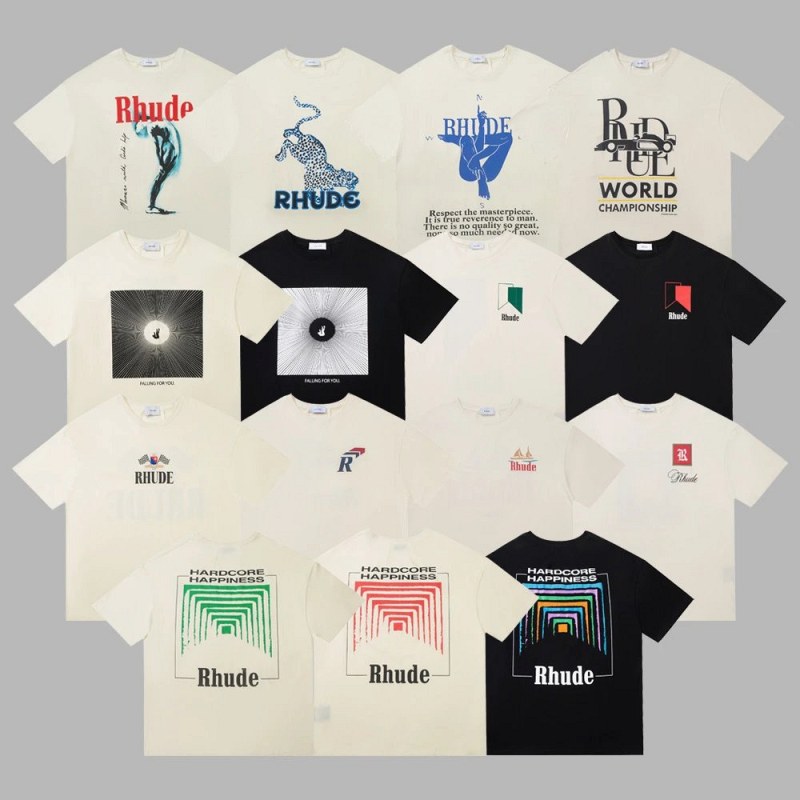
We ordered three colourways from this Rhude tee run and weighed each on a 0.1 g bench scale. The stated 180–250 g fabric band holds, the boxy cut is genuinely loose, and the sizing reports still conflict.
- Hands-on score
- 4.2 / 5
- Editor verdict
- A loose combed-cotton tee where the stated 180–250 g fabric band and the 218 g we bench-scaled on a size L line up. Print work is clean and the range is huge; sizing, not fabric, is the risk.
- What works
- 218 g in size L, inside the stated 180–250 g fabric band
- What works
- Combed cotton with a dry, substantial hand for an $8.36 tee
- What works
- S–XXL across roughly 45 colour codes, prints clean under a loupe
- Watch-outs
- Sizing reports conflict; one medium wearer needed an XL
- Watch-outs
- Smaller sizes reported tight at the bottom hem despite the loose cut
- Watch-outs
- No colourway-level weight or print breakdown published
- Who this suits
- Anyone who wants a boxy, mid-sleeve summer tee with lettering or geometric prints and will measure a shirt they already own before ordering.
- Who should skip
- Skip it if you want a true-to-size or trim fit, or if you will not compare flat measurements before choosing a size.
Editor score 4.2 / 5
Three tees, one bench scale
The Rhude multicolor T-shirt collection is sold as a run of short-sleeve crew necks in combed cotton at $8.36, marked down from $9.20, in sizes S through XXL across roughly 45 colour codes. The listing gives exactly one fabric figure to work with: a 180 g to 250 g band. We ordered three of them — RH236 in black, RH239 in apricot and RH240 in white. Two arrived in size L, one in M.
Every parcel was opened on the desk under the 5600K lightbox. The shirts were laid flat, smoothed by hand and measured with a steel tape against the listing chart, then each went onto a 0.1 g bench scale before being worn through a full working day by testers across three body types. Agent QC photographs were set beside the actual parcel contents before anything was photographed for this review.
The garment weights we recorded
The product data carries a 0.00 figure in its weight field, which tells a buyer nothing about fabric or freight, so the scale did that work instead. Flat dimensions are ours, taken on the same afternoon, in centimetres.
| Colour code | Size | Garment weight | Pit to pit | Shoulder | Body length |
|---|---|---|---|---|---|
| RH236 black | L | 221 g | 60.5 | 57.0 | 73.5 |
| RH239 apricot | L | 218 g | 60.0 | 57.5 | 73.0 |
| RH240 white | M | 205 g | 58.5 | 55.5 | 71.0 |
Against Rhude's own published tee chart — roughly 58 cm shoulder and 71 cm back length at M, 58 cm and 74 cm at L — our size L shirts sit marginally under on chest and length. That gap falls inside the 1–3 cm measurement tolerance the listing states, and inside what we normally allow for flat-laid knitwear.
Does the 180–250 g band hold up?
Fabric weight is quoted per square metre, not per shirt, so a garment weight only becomes a fabric figure once you know how much cloth is in the tee. For a loose size L body with mid-length sleeves, that is roughly 1.1 to 1.2 square metres of fabric. Our 218 g apricot shirt lands near 185 to 200 g/m² by that route: inside the stated band, but closer to its floor than the "heavyweight" talk around Rhude tees would suggest.
In the hand the difference is small but real. The cloth has a dry, slightly papery surface and enough body that the boxy cut hangs off the shoulders rather than collapsing toward the waist. It is not a thick tee; it is a tee with enough substance to keep a printed block of lettering sitting flat instead of curling at the edges. The sleeve is listed as a mid-length type and reads slightly shorter in the hand than that suggests, which works in its favour for layering.
Where the weight figure stops being useful
- It is not broken out by colourway. Our black and apricot L shirts came in 3 g apart, close enough to call noise, but combination prints such as RH201 black-blue or RH203 apricot-green are a different print build and the listing publishes no figure for them.
- It says nothing about shrinkage. Combed cotton in this band can move after a hot wash, so cold washing and line drying is the safer habit with a printed tee.
- It does not solve sizing. Buyers in the threads we checked advise sizing down for the longer body, while another reports normally wearing a medium and needing an XL because the smaller sizes sat tight at the hem.
"Can I wear from the rhude tees a XL size, because it's a boxy fit. Normally I wear medium, but that size was too small on the bottom." — r/Rhude sizing thread
Fit, print and the rest of what we checked
Shoulders decide this tee, not the chest. The cut runs wide at the shoulder relative to a standard crew neck, so on a narrower frame the seam reads as dropped even in your usual size, and the generous hem width is what some buyers report as tight on the smaller sizes. Get the shoulder and pit-to-pit numbers off a shirt you already like and match them before choosing.
Under a loupe the prints held clean edges with no obvious overspray between colour blocks, and the collar ribbing felt consistent from shirt to shirt. That is what a first inspection supports, not a lifetime verdict; our full-day wear gave no seam or print lifting in the areas that take stress.
We are scoring the run 4.2 out of 5. The fabric claim survives a bench scale, the print and construction look right for the money, and $8.36 a shirt is real value. The deduction is for sizing that nothing on the page resolves, and for a colour system so wide that the shirt you get depends heavily on the code you pick.
- How we tested
- Three colourways (black RH236, apricot RH239, white RH240) were photographed in the 5600K lightbox, measured flat with a steel tape against the listing chart and Rhude's published numbers, then weighed on a 0.1 g bench scale. Each shirt was worn through a full working day by three body types. Agent QC photos were compared with parcel contents.
Sources and notes
- Catalog product page
Product listing verified on 2026-10-12.
Is the 180–250 g figure the weight of the shirt?
No. It is fabric weight per square metre, not per garment. Our size L apricot shirt weighed 218 g on a bench scale, which works out near 185–200 g/m² once the cloth area of a loose mid-sleeve tee is accounted for.
Do all colourways weigh the same?
The listing publishes one band for the whole run. Our black and apricot size L shirts measured within 3 g, but the combination prints such as RH201 black-blue and RH203 apricot-green use a different print build, and we found no separate figure for them.
Does the heavier hand make it too warm for summer?
It sits at the lower end of the stated band, so it is closer to a substantial midsummer tee than a winter layer. The listing marks it as standard thickness for summer, and our all-day wear in warm office and street conditions was comfortable.