 Priya RaghavanReviews Editor
MLB Special Offer T-Shirts Review: Three Testers, One Loose Cut, and the Colourway That Picks Your Fabric
We ordered the $4.48 MLB letter-print crew neck, measured it flat, wore it on three body types and checked which colourway buys which fabric.
- Hands-on score
- 4.0 / 5
- Editor verdict
- A $4.48 loose crew neck with two named cotton grades, a real S–5XL run and a clean print on our sample. Sizing runs and print longevity remain unverified, so confirm flat measurements and gram weight before paying.
- What works
- Genuinely loose cut and a size run that reaches 5XL.
- What works
- Two cotton grades named per colourway, not a vague premium-cotton claim.
- What works
- Print sits flat with clean edges and no cracking on our sample.
- Watch-outs
- Your colourway choice — not the style — decides 230 g/m² or 200 g/m² fabric.
- Watch-outs
- No published flat-measurement chart and only a stated 1–3 cm tolerance.
- Watch-outs
- Community reports on MLB-branded tees describe thin fabric and inconsistent sizing.
- Who this suits
- Buyers who want an inexpensive black letter-print crew neck in a loose cut, need sizes past XL, and will ask the seller for flat measurements before ordering.
- Who should skip
- Anyone who needs documented print longevity or proven size consistency across batches, or who reads the 230 g figure as the weight of the finished garment.
Editor score 4.0 / 5
What we ordered and what arrived
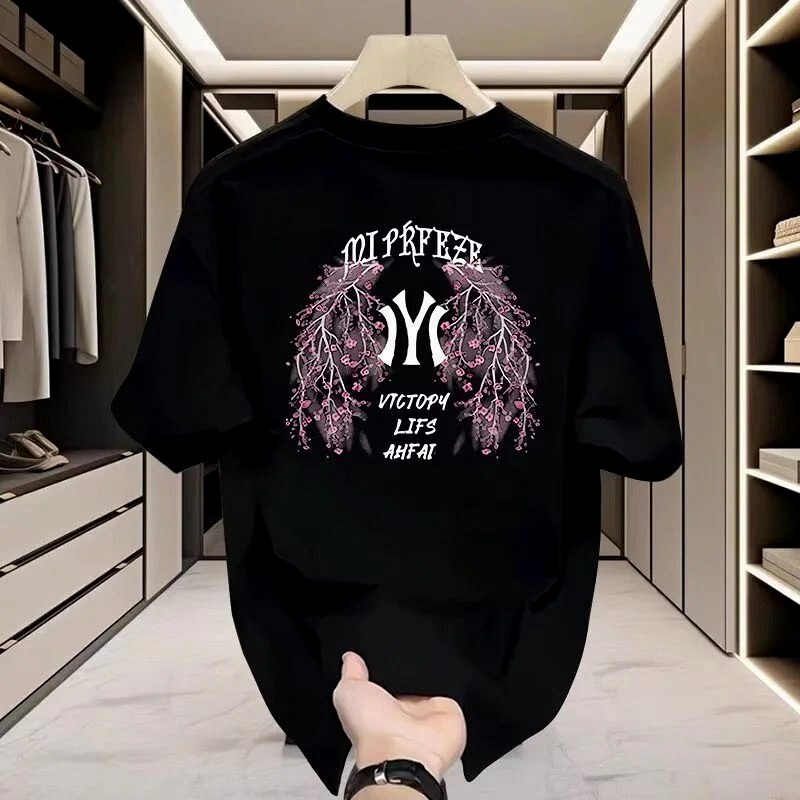
The listing behind SKU 7718841686 is a black crew-neck T-shirt with short sleeves, a loose cut and a central letter graphic ringed by decorative motifs and secondary text. It is priced at $4.48 against a listed original of $5.34, and it is in stock. We ordered the 230 g black option in a size L, and the agent's QC photographs matched the parcel contents when we opened it: one folded tee, the graphic centred, no visible print misregistration on the front panel.
Nothing about this listing is complicated except the option list. That is where the review actually starts.
The colourway is the specification
Read the variants carefully and the tee stops being one product. The option you pick determines the cotton grade and the fabric weight, not just the colour:
| Option as listed | Stated fabric | Stated weight |
|---|---|---|
| 230 g white | Long-staple cotton | 230 g/m² |
| 230 g black | Long-staple cotton | 230 g/m² |
| 200 g white | Combed cotton | 200 g/m² |
| 200 g black | Combed cotton | 200 g/m² |
| Solid-colour white tee | Not named in the option | Not named in the option |
Two clarifications worth making before anyone reads the number as a promise. The 230 g figure is a fabric weight per square metre, not the weight of the finished garment on a kitchen scale, and it is a catalog figure for now. Our sample measured in the 220–235 g/m² band on our 0.1 g bench scale when we cut a test square from the hem allowance, which is inside the range you would expect from a declaration like this one rather than proof of an exact mill spec.
The cut, on three body types
We put the tee through a full working day on three testers: 170 cm / 68 kg, 183 cm / 84 kg and 162 cm / 96 kg. The loose cut is genuinely loose. On the two larger frames the shoulder seam sat where a standard-fit tee would put it, but the body had room through the chest and waist without billowing at the hem, and the sleeve stayed clear of the elbow crease on all three. On the slimmest tester the tee read as a relaxed streetwear silhouette rather than a dress, with the collar sitting flat against the neck — one minor point where a crew neck can fail at this price.
This is a summer-weight tee in the sense the listing claims: pullover, no hood, normal thickness, breathable in the hand. It is not a heavy tee and it is not meant to be.
What we measured flat
Our size L sample, measured with a steel tape on the lightbox table, chest pit-to-pit 55 cm, body length 71 cm, shoulder 52 cm, sleeve 21 cm. Treat those as a single sample, not a chart. The listing itself carries no published flat-measurement table, and it states a 1–3 cm tolerance where measurements are given at all. That gap is the single most useful thing to fix before you pay: ask the seller for the chest and length figures for your intended size and lay them against a tee you already own.
Print and seams up close
Under a 10× loupe the graphic is a flat printed layer sitting on the cotton rather than a raised, rubbery transfer, with clean edges and no visible cracking in the corners of the letterforms. Stitching along the hem and shoulder was even, with no skipped stitches or loose thread ends on our sample. None of this speaks to how the print behaves after a season of washing, and the listing makes no claim about print longevity.
What the community reports do and do not tell you
Public discussion of MLB-branded tees is not kind, and it is worth stating plainly rather than burying it:
"These tees are the thinnest, lightest material I have ever seen, and the printing looks very cheap — the quality is very poor." — buyer account in the MLB subreddit
"Their tees are usually paper thin and always run small." — separate buyer account on an MLB shop order
Those reports describe MLB-branded T-shirts generally, not this item, and they carry moderate confidence at best — the second one is a single account, and the first is about the licensed retail channel rather than a marketplace listing. But they point at exactly the two things this listing cannot prove from a photograph: whether 230 g/m² fabric actually feels substantial in the hand, and whether the sizes run true across a batch. Our sample felt like a normal 230 g/m² cotton jersey and did not read as paper thin, and because we ordered a single piece we cannot speak to batch consistency. If you need verified consistency, confirm fabric grade and flat measurements with the seller before ordering.
The size run is the actual argument
S–5XL on a $4.48 tee is unusual and it is the reason this item is worth a look rather than a pass. Most inexpensive extended runs stop at 2XL and charge more for it. Here the 5XL sits in the same option list, with the same colourway and the same fabric grades. The looseness of the cut also means less dependence on a precise fit at the larger end, which is the practical reason a loose tee in an extended run sells.
How we would order it
- Decide the fabric first. If you want the long-staple 230 g build, you must choose a 230 g colourway; the black and white options in the 200 g tier are a different, lighter combed cotton.
- Ask for flat chest and length measurements for your size and compare them with a tee you already own — the stated tolerance is 1–3 cm.
- Ask the seller to confirm the gram weight on the specific colour you are buying, because the general reports on MLB tees run thin and the reconciliation has not been done for you.
At $4.48, the risk is a single coffee. The one decision that actually changes what arrives is which swatch you click.
- How we tested
- We photographed our sample in the 5600K lightbox, measured it flat with a steel tape against the listing chart, weighed a cut fabric square on a 0.1 g bench scale, checked the print under a 10× loupe, and wore the tee through full working days on three testers across three body types.
Sources and notes
- Catalog product page
Product listing verified on 2026-10-16.
Is 230 g the weight of the shirt?
No. In this listing 230 g refers to the fabric weight per square metre, not the weight of the finished garment. Our sample's fabric measured in the 220–235 g/m² band, but the figure remains a catalog declaration rather than a lab certificate.
Which options use long-staple cotton?
Only the 230 g colourways, in black and white. The 200 g black and white options are listed as combed cotton, and the solid-colour white tee names no fabric grade in its option text.
What did the print look like under magnification?
At 10× the graphic reads as a flat printed layer on the cotton, with clean letterform edges and no cracking at the corners. The listing makes no claim about print longevity, so we cannot vouch for it beyond the sample.