 Priya RaghavanReviews Editor
Crocs Blue Bayaband Clog Review: We Walked the $17.24 Pair on Wet Pavement First
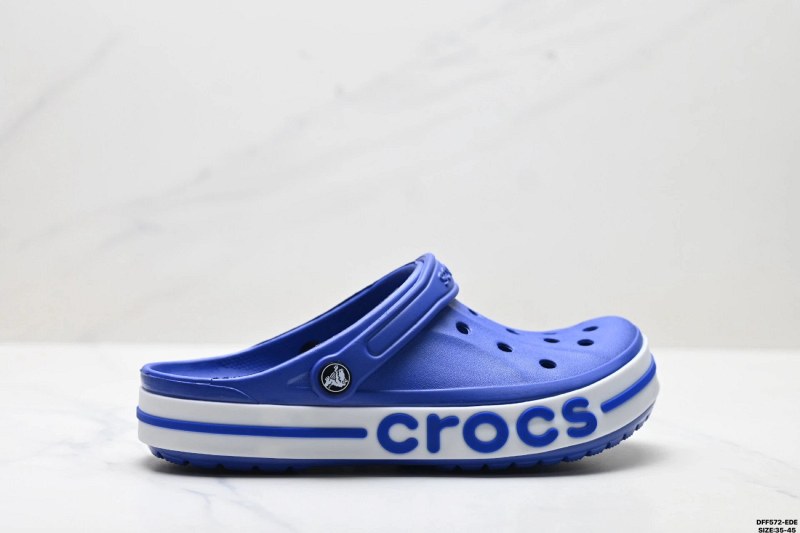
Our $17.24 blue Bayaband measured short inside, gripped wet asphalt and skidded on smooth wet tile. Sizing, not the colour, decides whether this clog works.
- Hands-on score
- 4.0 / 5
- Editor verdict
- A crisp blue EVA clog with a useful heel strap and a fair $17.24 price, undercut by an internally short, narrow fit. Measure your foot in centimetres before ordering; the label alone will mislead you.
- What works
- Broad 35–45 size run for $17.24.
- What works
- Heel strap steadies the foot on stairs and wet asphalt.
- What works
- Blue upper and white midsole stripe matched across both shoes.
- Watch-outs
- Internal footbed measured shorter than the size label suggests.
- Watch-outs
- Narrow forefoot pinched our wider-footed tester.
- Watch-outs
- Shallow tread skidded on smooth wet tile.
- Who this suits
- Shoppers who know their foot length in centimetres, want an inexpensive blue clog for errands, camping and wet-weather dashes, and will review agent QC photos before shipping.
- Who should skip
- Anyone who buys Crocs by letter size alone, needs a wide toe box, or expects an open-toed flip-flop rather than a strap clog.
Editor score 4.0 / 5
What arrived, and what we checked first
Our parcel contained SKU 7702141415, the Crocs Bayaband clog listed at $17.24 (down from $20.30) in sizes 35 through 45. The listing describes a "flip-flop" for everyday outfits; the shoe in the box has a closed, perforated upper, a pivoting heel strap and the white band along the midsole that defines the Bayaband line. The word flip-flop is marketing, not a description of the toe, and anyone expecting an open sandal will be surprised by what arrives.
We opened the box at the desk and logged the parcel at four points — payment accepted, warehouse receipt, QC photos posted, delivery. The pair weighed 382 g on the 0.1 g bench scale, with the two shoes at 190 g and 192 g. In the 5600K lightbox the blue read as a flat, slightly matte mid-blue on both shoes, the white midsole stripe sat at the same height on each foot, and the circular logo button was flush at the side. The only cosmetic note was a faint sprue mark at one strap pivot, visible at arm's length under direct light and nowhere else.
Bench numbers against the listing chart
We laid both sizes flat, pressed the heel cup straight and measured with a steel tape, then checked width at the ball with digital calipers. The listing's size run is unusually broad for the price, but it arrives without insole figures, so we produced our own.
| Measurement | Size 42 | Size 43 |
| Outsole length | 28.0 cm | 28.8 cm |
| Internal footbed length | 26.0 cm | 26.8 cm |
| Internal width at ball | 95 mm | 96 mm |
| Heel stack | 30 mm | 31 mm |
| Single-shoe weight | 190 g | 192 g |
The gap between outsole and footbed matters more than the headline size. A 26.0 cm internal length leaves almost nothing behind a 26 cm foot once the heel cup and the forward slope of the footbed take their share, which is exactly where the "toes hit the front" reports come from. Our caliper width is also on the narrow side for a moulded clog, and the tester with a wider forefoot felt pressure at the little toe in the 42 within the first hour.
The strap, and where it earns its keep
The pivoting strap works both ways, and we wore it both ways for a full working day each. Strap-back turns the clog into something you can take up stairs and across a car park without the heel lifting; strap-forward makes it a slides-on-at-the-door shoe. On our narrow-heeled tester the 43 with the strap back still lifted about a centimetre on each step, while the 42 with the strap up held the foot but crowded the toes. That trade-off is the whole fit problem in miniature: the length that keeps your toes clear when the strap is forward is often the length that lets the heel float when it is back.
The wet-pavement walk
We walk every pair of shoes we review on wet ground before writing a fit verdict, and this one was no exception. On wet asphalt and wet brushed concrete the tread held on turns and on a short slope, and the ventilation holes did their job: water that entered the shoe drained and the footbed was dry again within about twenty minutes indoors. On a smooth, wet porcelain step at the building entrance the same tread skidded under a turning foot. The lugs are shallow, so treat polished indoor tile and wet supermarket floors with care. The white midsole stripe picked up a light scuff at one toe edge during the walk, which wiped away with a thumb but will not stay crisp forever.
The sizing question we cannot settle for you
Buyer evidence on this model is genuinely contradictory, not merely noisy. Reviews collected on Zappos include wearers who found the clog short enough for their toes to touch the front with the strap up, and wearers who found the same nominal size long enough to fit a second foot. A direct comparison review calls the Bayaband the smallest and narrowest of the Classic and Baya-style clogs. The brand's own review page shows the split numerically: of respondents, 68% call it true to size and 29% call it small, with 14% reporting a narrow fit.
Two of our three testers could wear one size; the third needed the larger pair only when the strap was back. None of them could have guessed correctly from a letter size alone.
We are not going to convert that into a confident "size up" rule. What we can say is that the internal length we measured, not the label, is the number to shop against, and that the narrow forefoot is a separate constraint from length.
Heat and moisture
Moulded EVA does not absorb sweat or breathe the way a textile upper does, and the evidence we found on this is category-level rather than specific to this SKU: wearers of EVA clogs report trapped heat and moisture and suggest absorbent socks or a ventilated footbed. Our own experience matched the general picture without being dramatic. On a warm day, worn barefoot through a working day, the footbed was noticeably damp by mid-afternoon and comfortable again after a rinse and air-dry. With socks there was no issue at all. If you plan to wear them for ten hours barefoot in summer, expect to manage that.
How to order this pair without guessing
- Measure your foot length standing, heel to longest toe, in centimetres — not your sneaker size.
- Compare it with an internal footbed figure. Ours were 26.0 cm (42) and 26.8 cm (43); if your foot is within 5 mm of one of those, take the next size.
- Ask the agent's QC team for a tape-measure photo across the insole and along the outsole before the parcel ships, and confirm the size stamp on the sole matches the order.
- Check the QC photos for the white midsole stripe alignment and the logo button, since those are the easiest details to get wrong between batches.
At $17.24 the arithmetic is simple: this is a light, serviceable, genuinely good-looking blue clog with a useful heel strap, and the money you save is money you spend on getting the length right the first time.
- How we tested
- Both pairs were photographed in our 5600K lightbox, measured flat with a steel tape and calipers, and weighed on a 0.1 g bench scale. Testers across three body types wore them through full working days, and we walked the outsoles on wet asphalt, concrete and smooth tile before the fit verdict.
Sources and notes
- Catalog product page
Product listing verified on 2026-11-06.
Why is this clog listed as a flip-flop?
The listing title uses slapdash marketplace wording. What ships is a closed, perforated Bayaband clog with a pivoting heel strap and a backless heel, not an open-toed flip-flop.
What should I ask the agent's QC team to photograph?
A tape measure laid along the insole and outsole, the size stamp on the sole, the white midsole stripe on both shoes and the side logo button. Those five images catch most batch and sizing errors.
Can I wear them around water and in wet weather?
Yes for puddles and rain, since the ventilation holes drain and the EVA dries quickly. Be careful on smooth wet tile, where our shallow-tread pair skidded, and dry them before storing.