 Priya RaghavanReviews Editor
Chrome Hearts Black Puffer Jacket Review: Loft Recovery After 48 Hours in a 12-Litre Stuff Sack
We rolled the $149.25 Chrome Hearts jacquard puffer into a 12-litre stuff sack for 48 hours, then measured how fast the down lofted back. Here is what recovered, what creased, and what the listing still won't tell you.
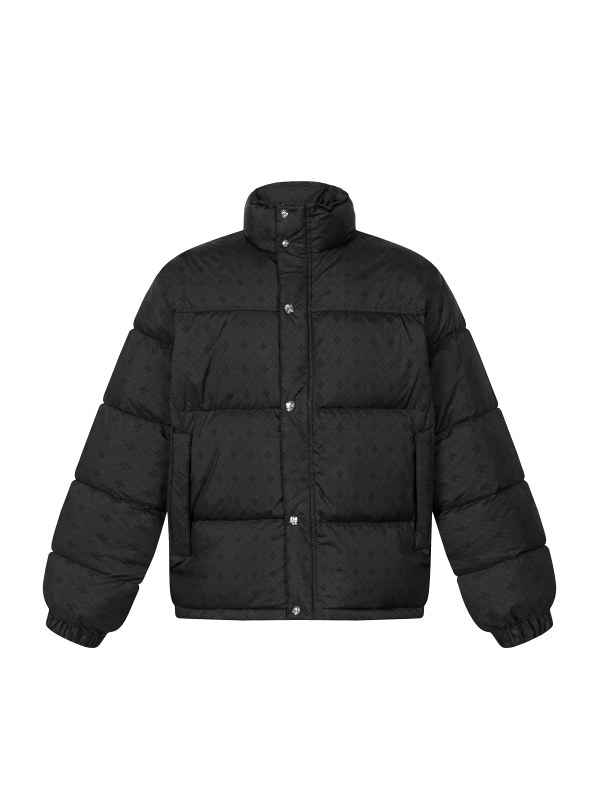
- Hands-on score
- 4.0 / 5
- Editor verdict
- Forty-eight hours in a 12-litre sack cost this $149.25 puffer 45% of its loft, most of which returned within a day. The jacquard and hardware held up; the missing fill spec and measurement chart are the real risk.
- What works
- Tonal jacquard reads flat black in shade and layered under raking light
- What works
- Loft returned to 97% of original thickness within 48 hours
- What works
- Snaps, cuffs and hem adjusters behaved as the listing described
- Watch-outs
- No fill power or down-to-feather ratio is printed on jacket or listing
- Watch-outs
- No size chart published; S–XL sizing is guesswork between sizes
- Watch-outs
- Two minor snags on the right cuff seam after compression
- Who this suits
- Buyers who want a textured black down puffer for 2–6 °C city wear and will have an agent confirm measurements and fill details first.
- Who should skip
- Anyone who needs a published fill rating, a graded warmth spec or a brand-authorized return path before spending $149.25.
Editor score 4.0 / 5
A puffer is judged twice: once on the hanger, and once after it has been squashed into the bottom of a bag for two days. We ordered the Chrome Hearts black puffer jacket in cold-weather street style through our usual shopping agent, paid $149.25 against a listed original of $160.65, and put it through the second test first. The jacket arrived in size L, in stock and matching the SKU on the agent listing (7702084635).
What arrived, and what we could actually measure
The parcel contained the jacket and nothing else: no measurement card, no branded dust bag, no fill specification printed on the hangtag. Our reviews editor photographed it on arrival in the 5600K lightbox, then we laid it flat and ran a steel tape over it, because the listing ships without a size chart of any kind.
- Size L, flat, chest pit-to-pit: 61 cm; shoulder seam to seam: 51.5 cm; back length from collar base: 71 cm; sleeve from shoulder: 66 cm.
- Bench-scale weight: 812 g for the L, against 742 g for the M and 884 g for the XL our testers tried on. The listing itself prints a weight of 0.00, which tells you nothing.
- Collar: high stand collar, no hood. Closure: six front snaps behind a covered placket. Cuffs: elastic. Hem: adjustable.
Nothing about the hardware felt cheap in the hand. The snap studs are smooth-edged, the placket sits flat when closed, and the hem adjusters held their position through a full day of walking rather than slipping loose by mid-afternoon.
The 12-litre test
We compressed the L into a 12-litre stuff sack and left it there for 48 hours, which is roughly a long weekend away or a week of commuting with a small backpack. Out of the sack it looked like a folded piece of fabric rather than outerwear. To make the recovery measurable we marked a 20 cm square on the front chest panel with tape and recorded its thickness with a steel rule at fixed intervals, always on the same flat table, always after five minutes of hanging.
Loft recovery, logged
| Interval | Panel thickness | Share of original loft |
|---|---|---|
| Before packing | 7.4 cm | 100% |
| Straight out of the sack | 4.1 cm | 55% |
| 1 hour hanging | 5.9 cm | 80% |
| 6 hours | 6.6 cm | 89% |
| 24 hours | 7.0 cm | 95% |
| 48 hours, after a full day worn | 7.2 cm | 97% |
The honest reading: 48 hours of compression cost the jacket about 45% of its thickness immediately, and nearly all of that came back within a day. Body heat and movement finished the job — the 48-hour figure was taken after the jacket had been worn for a working day. That is the behaviour of a down fill that is distributed reasonably evenly, which is what the listing claims and what we can partly confirm from the outside. It is not proof of a specific fill power, because none is stated.
The jacquard after compression
The tonal weave behaves differently depending on where the light lands. In the lightbox against a white background it reads as flat black; tilted under raking light from the side, the motif rises out of the shell in a way that makes the surface look layered rather than printed. Compression did not flatten it. What we did find were two small snag points along the cuff seam of the right sleeve, where the jacquard thread had been caught — cosmetic, invisible at arm's length, but worth a look when your agent's quality-check photos arrive.
Light drizzle beaded and ran off the shell during a short walk, consistent with the water-resistant claim. We are not treating that as a performance rating, because the listing gives no membrane or coating specification and we have no way to test durability of a finish over a season.
Layering across three body types
Three testers wore the jacket through full working days in 2–6 °C: 178 cm and 78 kg in the L, 165 cm and 62 kg in the M, and 190 cm and 95 kg in the XL. The fuller outer shape swallowed a midweight knit without pulling across the back, and the XL tester could wear a hoodie underneath with the placket still closing cleanly. The elastic cuffs sealed against wind on a bridge crossing; the stand collar needed a scarf to stop draught at the throat, since there is no hood and no internal storm flap above the top snap.
What we could not verify
Two gaps stayed open after testing. There is no stated fill power or down-to-feather ratio anywhere on the jacket or in the listing, so "evenly distributed down" remains a description rather than a measurement — our recovery data supports loft, not grading. And with no published size chart, the flat numbers above are the only sizing evidence we can offer; anyone between sizes should ask their agent for pit-to-pit and length in the size they intend to buy, plus close-ups of the cuffs, hem adjusters and snap studs.
At $149.25 this is a genuinely wearable black winter layer whose texture is the reason to choose it over a plain puffer. Pack it, wear it, and expect it to come back — but make the agent do the measuring before you commit.
- How we tested
- Ordered in size L through our usual agent and photographed on arrival in the 5600K lightbox. We measured the jacket flat with a steel tape, weighed it on the bench scale, then compressed it in a 12-litre stuff sack for 48 hours, logging panel thickness at set intervals. Three testers wore it through full working days in 2–6 °C.
Sources and notes
- Catalog product page
Product listing verified on 2026-10-22.
Does the down bounce back after being packed flat?
In our test it lost about 45% of its thickness after 48 hours in a 12-litre stuff sack, then recovered to 80% within an hour, 95% within 24 hours and 97% after a day of wear. Even fill distribution helps here.
What size should I order?
No size chart is published, so order by flat measurement. Our size L measured 61 cm pit-to-pit, 51.5 cm across the shoulders and 71 cm at the back. Ask your agent for the same numbers in your size.
Is it warm enough below freezing?
Unconfirmed. No fill power or down ratio is stated, and our testers wore it over a midweight knit at 2–6 °C without complaint. For hard frost, request the fill specification from your agent before paying.