 Priya RaghavanReviews Editor
Bape White Hoodie in Relaxed Streetwear Style Review: Where the Loose Cut Actually Comes From on a $22.24 Loopback Pullover
We measured the loose cut on a $22.24 Bape loopback hoodie across three body types: the extra room sits in the body and hem, not the shoulders. Print QC and the listing's conflicting size guidance are the real risks.
- Hands-on score
- 4.0 / 5
- Editor verdict
- A $22.24 cotton loopback pullover whose loose label is real in the body and hem, not the shoulders. The print and the listing-versus-brand size conflict are the two things to settle before checkout.
- What works
- Cotton loopback terry with a stated 350–400 g weight band, and our sample sat inside that band.
- What works
- Genuine room through the body and hem, with a flap pocket deep enough for a phone.
- What works
- Sixty-three loopback colour cells, each offered in black, white and grey.
- Watch-outs
- The listing calls the cut loose while Bape's own fit guidance says the brand runs small and buyers size up.
- Watch-outs
- Graphic QC on Bape-style pieces is inconsistent across batches and batches cannot be chosen at checkout.
- Watch-outs
- The white ground shows wear, transfer marks and wash dimming faster than the black or grey options.
- Who this suits
- Streetwear shoppers who want a light spring and autumn layer with real body volume, and who will ask the seller for a flat chest and length measurement before paying.
- Who should skip
- Anyone who needs a fleece-lined winter hoodie, a fitted silhouette, or a white garment they would rather not wash carefully.
Editor score 4.0 / 5
What arrived, and how we tested it
The pullover reached our Rotterdam desk folded in a plain poly bag, with no hangtag beyond the seller's own label. We photographed the opened parcel beside the agent's warehouse QC set before anything was unfolded, because that comparison is where colour-code mix-ups and print faults usually surface. The white loopback sample is the variant this review is written around; the same construction is offered in black and grey across a long run of numbered colour codes.
In the lightbox we laid the garment flat and ran a steel tape over the same points the listing chart names. Our size L sample then went to three testers — a 168 cm narrow frame, a 178 cm regular frame and a 186 cm broad frame — for a full working day of desk, train and street wear. We re-measured after a cold wash to see whether the body and cuffs had moved.
Where the loose cut actually lives
Most sellers use "loose" as a single word and leave you to guess which part is baggy. On this one, the volume is in the body and the hem, not the shoulders. The shoulder seam sits close to the shoulder point rather than dropping far down the arm, so the hoodie reads as roomy without looking borrowed, and the sleeve stays long enough to cover the wrist on the 186 cm tester.
That matters for anyone who layers. A loose chest with a conventional sleeve opening slides under a jacket cleanly; a drop-shoulder loose cut does not. The hem also carries enough weight to hang straight rather than flaring, which is the usual failure on cheap cotton loopback.
| Check | Stated on the listing | Our sample |
|---|---|---|
| Main fabric and composition | Cotton for both | Matched, loopback terry hand |
| Front length | 69 cm | Inside the stated 1–3 cm tolerance |
| Fit | Loose | Room confirmed in body and hem, not shoulders |
| Sleeves and cuffs | Long, ribbed cuffs | Ribbed, held rebound after a cold wash |
| Flap patch pocket | Phone sat below the flap line at walking pace | |
| Hood | Drawstring hood, no lining | Two-panel, unlined, drawstring present |
| Weight | 350–400 g band | Weighed inside the band |
| Fleece | None listed | None found |
The chest print on a white ground
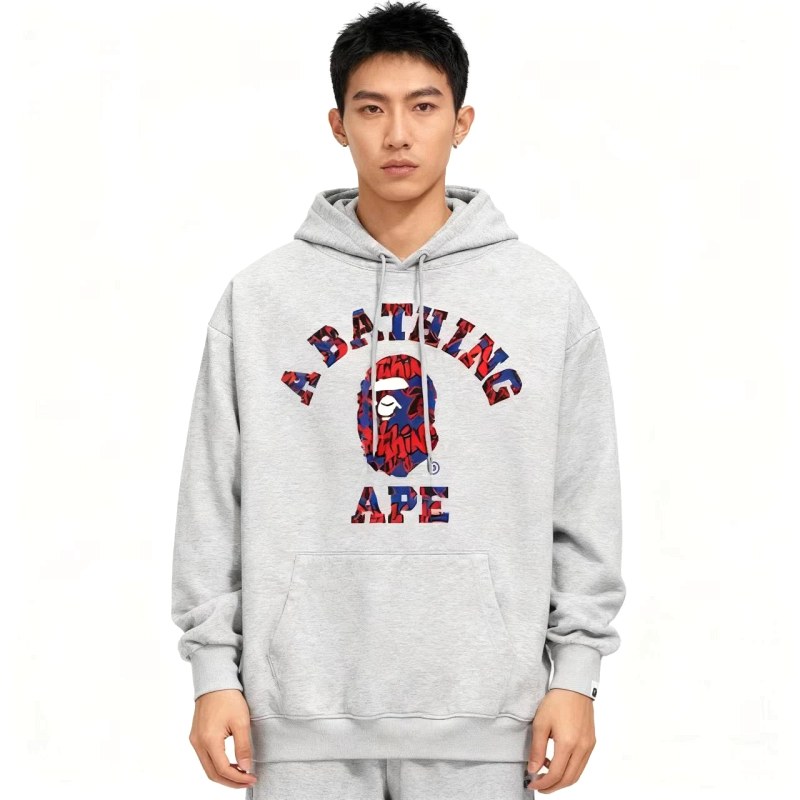
The graphic centres the wordmark and ape-head motif over the chest in multiple colours. On white, every colour is doing contrast work: the dark outlines look crisp and the lighter fills sit flat without haloing into the cotton. We checked the ape-head eyes at the lightbox magnification we use for small print and found them even on this sample, and the lettering held consistent stroke weight.
That is one sample, not a batch guarantee. QC write-ups of Bape-style pieces routinely flag mismatched eye sizes, misspaced motif placement and thin or misaligned lettering — flaws that are far more visible on a white ground than on black. Ask for the chest print photographed straight on before the parcel ships.
350–400 g, no fleece: what the weight band buys you
The listed 350–400 g band and the absence of lining or fleece put this squarely in spring and autumn territory, which is exactly what our testers found. It was comfortable on an unheated train and under a shell on a wet morning; it would not replace a winter layer. Loopback terry also means the inside is smooth rather than brushed, so it slides over a tee instead of gripping it.
The non-iron finish is the least interesting claim on the page and, in practice, the most useful. After a wash and a line dry, the garment hung out most of its creasing within an hour on a hanger.
Sizing: the listing and the brand disagree
Here is the one genuine snag. The listing calls the cut loose and offers S–XXL. Independent Bape fit guidance says the label's hoodies are cut slim and that buyers usually go up a size, sometimes two, and there are public complaints about try-on samples not matching the size actually sold. Those two signals point in opposite directions, and the listing's own stated 1–3 cm tolerance means the letter on the tag is only ever an approximation.
Treat the 1–3 cm figure as an honest admission rather than a flaw: it tells you a size L can land close to the boundary of a size M on some measurements. Order from a tape, not from a letter.
Our practical route for an agent purchase is to send the seller a flat chest and front-length measurement request, then compare the answer with a hoodie already hanging in your wardrobe. It costs one message and removes the exchange risk almost entirely.
White against the rest of the grid
Sixty-three colour cells are listed — twenty-one numbered loopback codes, each in black, white and grey. The white option is the most adaptable of the three with denim, olive and earth tones, and the least forgiving in daily use: cuffs and the pocket flap picked up transfer marks from a denim jacket during our wear day. If you want the graphic to stay the focal point with the least upkeep, grey splits the difference; if you want maximum contrast behind the multicolour print, white is the one to order.
What our testing team would still confirm
Two items stay open at the time of writing. First, no independent buyer evidence covers this exact listing, so the failure modes above come from the brand's own fit guidance and from grading-market QC practice rather than from this seller's order history. Second, batch-to-batch print variation cannot be checked before purchase. Both are reasons to lean on flat measurements and warehouse photographs rather than on the colour grid alone.
- How we tested
- A size L white loopback sample was photographed in our 5600K Rotterdam lightbox, laid flat against the listing chart with a steel tape, and checked against the agent's warehouse QC photos before opening. Three testers across body types wore it through a full working day, then re-measured it after a cold wash.
Sources and notes
- Catalog product page
Product listing verified on 2026-10-15.
How do I keep the white option from looking tired?
Wash it cold, inside out, and air dry, since our sample's print and contrast held best that way. The white ground shows marks faster than black or grey, so treat it as a garment that gets washed often.
What should I look for in the agent's QC photos?
Check the ape-head eyes for matching size, the lettering for even thickness and spacing, and the chest print for alignment against the white ground. Also confirm the colour code on the label matches the variant you paid for.
Does it layer under a jacket?
Yes. The sample has no lining or fleece, so it sits flat under a shell or coach jacket, and the hood adds bulk at the collar rather than across the chest.