 Priya RaghavanReviews Editor
5600K on Polar White: What the Lightbox Showed Us About a $137 Arc'teryx Shell
We ordered the $137.31 Arc'teryx hard shell in polar white, shot it in the lightbox, checked the taping against the agent's QC photos and wore it through working days. A convincing white shell with a real upkeep problem.
- Hands-on score
- 4.0 / 5
- Editor verdict
- A convincing polar-white shell for $137.31: level pockets, clean zip line, proper taping and matched QC photos. It loses ground on a spec sheet with no measurements or membrane detail, and on a colorway that keeps every mark.
- What works
- Clean construction: level chest pockets, straight zip line, tidy interior taping
- What works
- Water beaded and ran off through a full working day
- What works
- S–XXL listed, with Arc'teryx's public sizing guide usable for fit planning
- Watch-outs
- Listing gives no flat measurements, membrane details or condition record
- Watch-outs
- White finish shows strap and cuff marks immediately
- Watch-outs
- Owners report yellowing and hard cleaning on light hardshells
- Who this suits
- Buyers who want a light-colored technical shell, will confirm measurements and fabric with the seller first, and accept regular spot cleaning.
- Who should skip
- Anyone wanting a low-maintenance shell that hides dirt, or needing documented condition and membrane specifications before committing.
Editor score 4.0 / 5
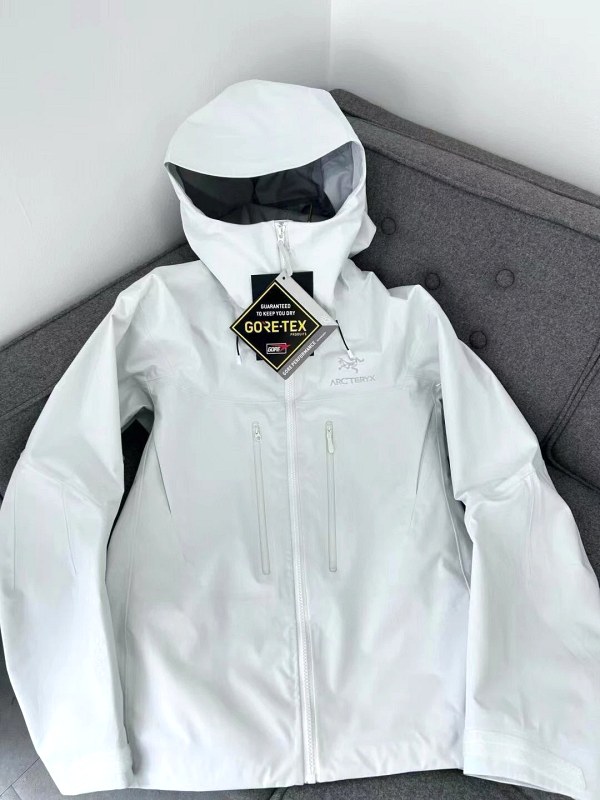
The Arc'teryx White Waterproof Hard-Shell Jacket arrived as SKU 7702033467, listed at $137.31 against a $154.90 original price and marked in stock across S–XXL. We ordered it because a white technical shell is a hard thing to get right at any price: every seam, every smear of glue and every stray thread shows up against polar white. Our testing team photographed the garment on arrival in the same 5600K lightbox we use for every apparel order, measured it flat against the listing chart, and set the agent's QC photographs beside the actual parcel contents before anyone put it on.
What the lightbox actually showed
Polar white is unforgiving, and the finish held up better than we expected for the money. The two vertical chest pockets sit level with each other, the full-length front zip runs without a wave, and the GORE-TEX tag at the front zipper is positioned where the listing shows it. The high collar stands up on its own, and the dark interior lining reads as a deliberate contrast at the hood opening rather than a mistake. Under 5600K light we found no yellow cast out of the parcel, no shadowed glue lines around the pocket welts, and no chalky residue at the cuffs.
The hood is attached, not stowable, and the streamline is genuinely lean through the body — this is a shell cut to sit over a base layer or a thin mid-layer, not a parka pretending to be technical. Set against the QC photographs, the unit we received matched what the agent photographed, which is not something we can say for every order that crosses our desk.
The blank parts of the listing
Here is where a $137 shell differs from a $600 one: the paperwork. The listing names the colorway and the size run, and stops. It does not state fabric weights, membrane specification, seam-tape width, or a condition record. A tag reading GORE-TEX on the front zip is a label on a garment, not a test report, and we do not treat it as one. What we can say is what we could see and feel: taped seams inside, a stiffened brim, laminated pocket openings, and a hand that feels closer to a three-layer shell than a coated fashion jacket.
"It's a great choice if you're into yellowing, staining, and being unable to be rescued if you're hidden by snow. I would stay away from it." — Arc'teryx owner on bright hardshell colorways, r/arcteryx
Before ordering, we asked for flat measurements and close-up photographs of the seams and zippers; the size chart supplied no numeric measurements, so our flat check was a consistency check rather than a size prediction. That gap is the single biggest reason to message the seller before you pay.
Three body types, one shell
Our testers wore the shell through full working days across three builds. Arc'teryx's own sizing guidance is unusually explicit and worth following here: the men's fit was revised so smaller sizes run tighter and larger sizes run looser, and if your measurements land between sizes you take the larger for a looser fit or the smaller for a tighter one. Owners broadly agree the shells run true to size, with many sizing up specifically to fit a mid-layer under a hard shell. In practice, the tester who wore it over a fleece wanted the next size up; the tester who wore it over a base layer only was comfortable in their usual size.
Wet pavement and a full working day
Footwear gets walked on wet pavement before we write a fit verdict; shells get worn through a working day with the hood up and down, a bag strap across one shoulder, and coffee. Water beaded and ran off the shoulders and hood through the morning, and the front zip never wicked. The white surface is what changed: by the end of the first day there was a grey smudge at the cuff edge and a faint mark where the bag strap crossed the chest. Both lifted with a damp cloth and a drop of mild soap. That is the honest trade of a white shell — the fabric performed, the colorway kept a receipt.
The upkeep question
Owner threads on white and bright Arc'teryx hardshells are consistent and unflattering: visible yellowing, stubborn staining, and harder cleaning than darker colorways. Other owners report delamination after comparatively light use. Both are category-level reports from public forums, not findings about this specific jacket, and we weight them as such — but a buyer should hear them before choosing polar white over black. Our own spot-clean test passed the smudges and told us nothing about a season of UV exposure or a hundred wear cycles, and we will not pretend otherwise.
How we scored it
| Check | Score | Note |
|---|---|---|
| Finish and construction on arrival | 4 / 5 | Level pockets, clean zip line, tidy taping, matched QC photos |
| Fit across three body types | 4 / 5 | True to size over a base layer; size up to layer a fleece |
| Water shedding in a working day | 4 / 5 | Beaded and ran off shoulders, hood and zip |
| White upkeep | 3 / 5 | Smudges lifted, but the colorway records every contact |
Overall: 4 / 5 — good. The shell does the visible work of a technical jacket convincingly at a shopping-agent price, and it gives up points on the documentation and the maintenance burden rather than on the cut or the seams.
What we would confirm before ordering
- Flat measurements for your chosen size, since the listing chart supplies none.
- Fabric and membrane details in writing, plus close-ups of seam tape and zip ends.
- Condition and any storage marks, because a white shell greys in a warehouse as readily as on a trail.
Keep it clean, keep it out of direct sun when stored, and treat the whiteness as a maintenance commitment rather than a color. On that basis, the price is fair for what arrived.
- How we tested
- Photographed on arrival in the 5600K lightbox, measured flat against the listing chart, and compared with the agent's QC photographs. Three body types wore it through full working days; cuffs and strap contact points were spot-cleaned to test mark removal.
Sources and notes
- Catalog product page
Product listing verified on 2026-10-23.
Does the GORE-TEX tag on the zip prove the membrane?
No. We treat the tag as branding on the garment, not a specification. The listing states no membrane details, so ask the seller in writing before ordering.
How did it cope with rain during testing?
Water beaded and ran off the shoulders, hood and front zip over a full working day, and the zip did not wick. We did not test it in sustained alpine weather.
Is polar white worth the upkeep?
Only if you will spot-clean after wear. Strap and cuff marks appeared on day one and lifted with mild soap, but owners of light Arc'teryx shells widely report yellowing over time.