 Priya RaghavanReviews Editor
Arc'teryx Shell Jacket with Liner Review: We Wore It Three Ways Over One Working Week
We ordered the two-piece shell and liner through a Kakobuy agent, measured both layers flat, then wore the set three ways across a working week. The layering works; the sizing and the down spec are still on you to verify.
- Hands-on score
- 4.0 / 5
- Editor verdict
- A genuinely useful two-piece winter setup for $181.79, with the liner doing real work. It loses a point for an unverifiable down spec, no published size chart and a colour line that contradicts the photos.
- What works
- Two wearable layers for $181.79, which makes the liner close to free
- What works
- Shell cut roomy enough to layer; seam tape, cuffs and hem hardware all checked out
- What works
- Sizes S–3XL, a wider run than most Arc'teryx shell listings
- Watch-outs
- No flat-measurement chart, so between-size orders are a gamble
- Watch-outs
- Down fill and liner construction come from seller copy, not a readable label
- Watch-outs
- Black in the photos, Egyptian orange in the spec line — confirm before paying
- Who this suits
- Cold, wet-weather commuters who want one purchase to cover autumn rain and winter cold, and who will message the agent for measurements before paying.
- Who should skip
- Buyers who need a guaranteed fit straight out of the box, or who want a published membrane and fill rating rather than our field notes.
Editor score 4.0 / 5
Three-in-one jackets usually sell the idea of choice and deliver a heavy coat with a zip-in afterthought. This listing, SKU 7702116103, is the more interesting version of that promise: a hooded shell plus a quilted hooded liner, sold together at $181.79 (down from $198.10), in sizes S through 3XL. We ordered one through our Kakobuy agent, checked the warehouse QC photographs against the parcel when it landed, and then spent a working week wearing it shell-only, liner-only and zipped together.
What actually arrived
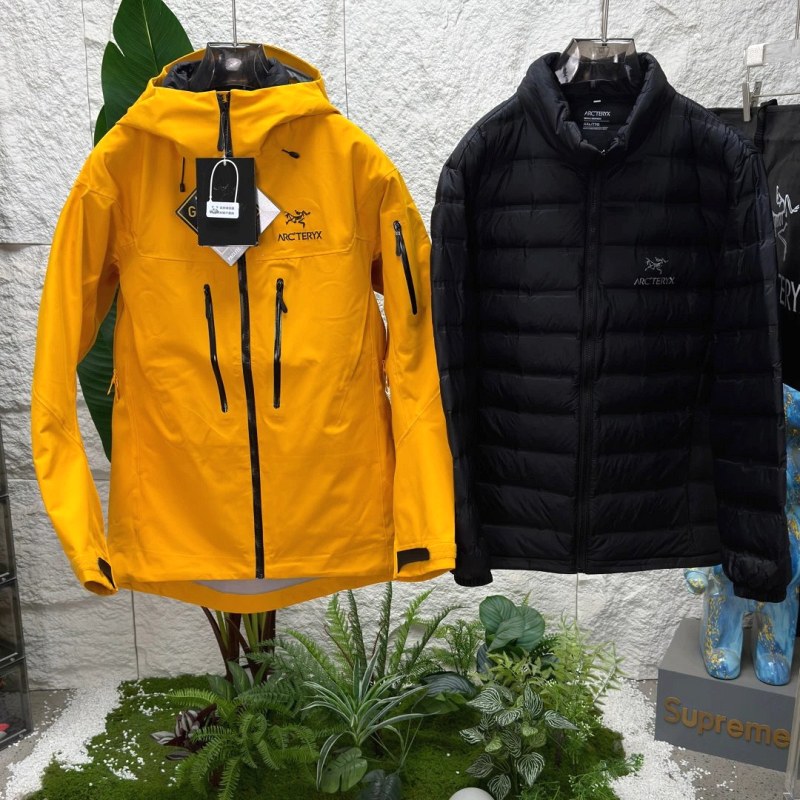
One black shell, one black quilted liner, both carrying the Arc'teryx chest logo, packed as a single set. The shell has a full-front zip with a storm flap behind it, two zippered hand pockets, a zippered chest pocket, hook-and-loop adjustable cuffs and a drawcord hem. Taped seams are visible inside the body and across the shoulders. The liner is a stitched-through quilted piece with its own hood and its own front zip, attached inside the shell by a zip track at the back of the neck and loops at the cuffs.
Under our 5600K lightbox the shell read as a matte, slightly stiff face fabric rather than a softshell — consistent with the hard-shell cut the listing implies. The liner is far lighter than the shell and compresses to roughly the size of a folded fleece. One caveat we noted on arrival: the listing's images and title say black, while the seller's feature line carries an Egyptian orange colour tag. Our parcel was black.
The tape measure versus the listing
There is no flat-measurement chart attached to this listing, which is the single biggest problem with buying it. We measured the size L we kept, laid flat, steel tape, garment relaxed:
| Measurement (size L, flat) | Shell | Liner |
|---|---|---|
| Pit-to-pit | 62 cm | 59 cm |
| Back length, collar seam to hem | 77 cm | 68 cm |
| Sleeve, centre back to cuff | 92 cm | 88 cm |
Tolerance on those numbers is about a centimetre, and the shell's pit-to-pit sits inside the band the brand's own men's chart gives for a large. The silhouette, though, is the roomy hard-shell cut: enough space for the liner plus a mid-layer, with sleeves that run long on our shorter tester (173 cm) and only just clear the knuckles. Our two taller testers, at 181 cm and 188 cm, found the sleeve length right where it should be.
This is where the buyer reports we found matter. Arc'teryx shell sizing is widely described as inconsistent between sizes — a medium that fits too tight, a large that feels like a tent, sleeves running long — and outdoor-community sizing guides note that hard shells are cut looser than soft shells precisely so they can layer. Both point the same direction: do not order this set on the size tag alone. Ask the agent for pit-to-pit and back length in the exact size you want.
One working week, three ways
Shell only. Worn over a shirt on wet, 9–13°C Rotterdam days, it kept wind out and shrugged off steady rain for a 25-minute walk. The hood is helmet-sized, which is great over a beanie and less great in traffic — it needs the rear adjuster cinched or it drops forward.
Liner only. The quilted layer works as a standalone mid-layer and is the more versatile half of the pair for mild days. It is not a jacket you would trust in rain on its own.
Both, zipped in. The connection is straightforward: the liner's top zip engages the shell's internal track, then the cuff loops. It took two attempts to seat the track cleanly, after which it stayed put through a full day of sitting, walking and coat-on-coat-off. The awkward part is the double hood. The liner's hood bunches under the shell's, and because the shell hood is generously cut, you feel the extra fabric behind your neck until you flatten it. Worn as intended — shell hood up, liner hood down — it is comfortable.
Three testers, three body types, one shared verdict: the layering is the reason to buy this, and the fit is the reason to measure first.
Where the listing wobbles
Two things remain unverified after our week. First, the down: the three-in-one and down-jacket framing comes from the seller's copy, not from a tag we could fully read, so fill type, fill weight and liner construction are unknown. Ask for a close-up of the liner's care and content label. Second, the colourway conflict above — our black parcel does not prove an orange option exists, or the reverse.
Brand reputation is worth separating from this item. Arc'teryx's own Trustpilot page sits around 2.3/5, with long-standing customers complaining that premium pricing has not been matched by quality and service. That is context on the label, not a finding about the jacket in our box, which showed clean stitching, straight seam tape and no loose threads.
The money
At $181.79 for two wearable layers, the arithmetic is the strongest argument here. Even if you value the liner at a modest $40–50, the shell lands in the range of a mid-tier rain shell — and unlike most single-layer options at that price, you get a winter configuration without buying a second coat. What you are paying for is flexibility, not certification: no waterproof rating, membrane name or fill spec is published, so treat the weather protection as field-tested by us over one wet week rather than guaranteed on paper.
Our advice is unchanged from the moment we opened the parcel. Confirm measurements for your size, confirm the colour, ask for the liner label, then buy. The jacket is good; the listing is the weak link.
- How we tested
- Ordered via Kakobuy; QC photos compared with parcel contents. Both layers photographed in a 5600K lightbox and measured flat with a steel tape. Three testers (173, 181, 188 cm) wore shell, liner and both across a working week in wet, 9–13°C conditions.
Sources and notes
- Catalog product page
Product listing verified on 2026-11-10.
Can the liner be worn on its own?
Yes. The quilted liner has its own hood, front zip and cuffs, and our testers wore it as a standalone mid-layer on mild days. It is warm but not weatherproof, so it is a jacket for dry cold rather than rain.
Is this one coat for winter, or a rain jacket?
It depends how you zip it. The shell alone handled steady rain and wind on a 25-minute walk; together with the liner it covers cold, wet days. Neither configuration is rated for deep winter on its own.
What should I ask the agent before paying?
Flat pit-to-pit and back length for your exact size, confirmation of the colourway, a close-up of the liner's content label, and confirmation that the liner is included in the option you selected.